Too often, healthcare media plans begin with channel-focused questions: Which platforms should we use? How much reach can we buy? Which formats belong in the media mix?
While these questions are no doubt valuable during tactical planning, they have no place in initial campaign strategy.
For Point of Care (POC) planning, a more useful starting point is considering the moment when a patient and healthcare professional (HCP) are navigating a care decision together, then working backward to anticipate patient and HCP needs at each stage of the care journey.
POC pioneer Mike Collette described this philosophy simply: “Build your media plan from the provider’s office, or more specifically, the exam room back.” Centering planning on solving for the moment of care allows you to make the realities of care the organizing principle for your broader strategy.
In the first two posts in our series on more effective POC planning, we explained why Point of Care (POC) should be treated as foundational spend and why reach and relevance perform different—but complementary—jobs. Our next step is putting those principles into practice.
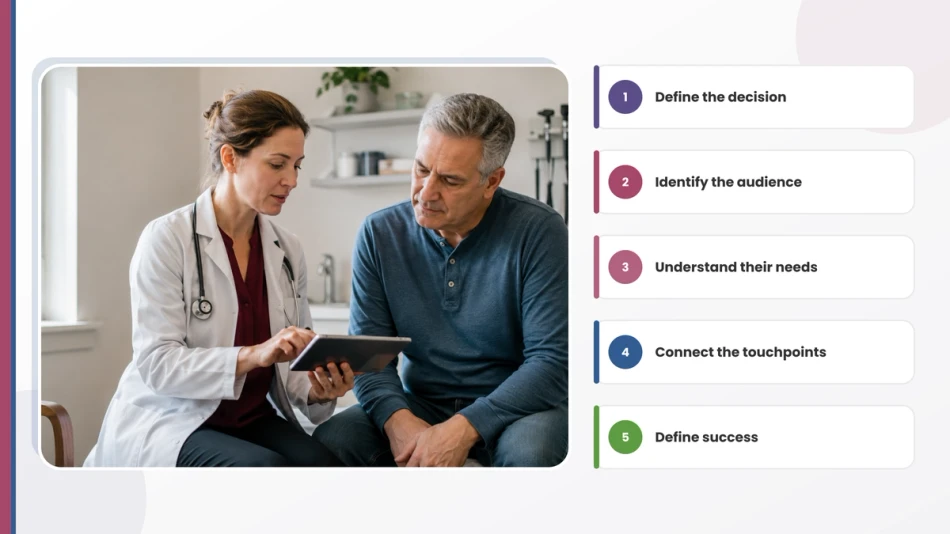
We recommend answering this simple five-question framework during planning to stay on track:
- What decision or care transition are people navigating?
- Who matters to that decision?
- What does each audience need?
- How should the touchpoints connect?
- What would success look like?
Marketing should never substitute for clinical judgment. Its role is to make credible, relevant information easier to access so that patients can ask informed questions, healthcare professionals can locate useful resources without unnecessary friction and both can continue the conversation beyond the appointment.
That distinction changes the planning process. Instead of asking where a brand can place a message, marketers begin by asking what patients and providers are trying to accomplish.
Step 1: What Decision or Care Transition Are People Navigating?
Before selecting audiences, messages or media, define the real-world moment your campaign is intended to support. Depending on the brand and disease state, that moment could include:
- Recognizing symptoms and deciding to seek care
- Preparing for a diagnostic conversation
- Understanding a new diagnosis
- Comparing appropriate treatment options with an HCP
- Starting or switching a prescribed therapy
- Navigating coverage, affordability or prior authorization
- Filling a prescription and beginning treatment
- Managing side effects or administration requirements
- Continuing therapy as directed
- Preparing for a follow-up conversation
The more precise the decision or transition you identify, the easier it becomes to identify the right role for your media. A useful planning prompt is:
What should the patient, caregiver or HCP be better prepared to discuss, decide or do after encountering this campaign?
If the answer is unclear, the campaign is not ready for tactical planning.
Step 2: Who Matters to the Decision?
Once the decision is defined, it’s time to map the people who shape it.
Healthcare audience planning can sometimes reduce the care journey to a patient and a physician. But in practice, care is delivered by a much broader team. Depending on the condition and setting, that team may include:
- The patient
- Family members and caregivers
- Physicians and specialists
- Nurse practitioners and physician associates or assistants
- Pharmacists and specialty pharmacists
- Practice managers, care coordinators and office staff
- Access, reimbursement and prior-authorization teams
The roles will vary by disease state, geography and practice setting. The important point is that prescribing authority is only one form of influence. One clinician may diagnose, another may educate, an office team may navigate access and a pharmacist may help determine whether the patient successfully begins and continues therapy.
POCMA’s 2027 planning blueprint reflects this reality in several of its ten principles for high-impact campaigns: build the right audience, bridge HCP and patient engagement and do not overlook pharmacists or the broader care team.
Patient and caregiver perspectives matter here as well. Patients frequently rely on families, advocates and trusted clinicians to help them navigate treatment.
For each person in the decision system, ask:
- What role do they play?
- When do they become involved?
- What do they know that others may not?
- What question or barrier are they responsible for addressing?
- Whose support is required for the care plan to move forward?
This exercise may reveal that the most important audience is not just the prescribing physician. It may be the nurse who explains administration, the pharmacist who addresses affordability or the caregiver who helps the patient follow through at home.
Step 3: What Does Each Audience Need at That Moment?
After identifying the audiences you’re trying to reach, define what would be useful to each of them. This is where your messaging and content begin to take shape.
What would be useful to your target audience(s) should go beyond “a branded message.” Patients and HCPs arrive at the point of care with specific tasks, concerns and constraints. Effective educational content helps address those needs without creating additional noise.
Before an appointment, patients may need:
- Plain-language condition education
- Help identifying symptoms or changes worth discussing
- Questions they can bring to the visit
- A clear explanation of what to expect
- Encouragement to involve a caregiver
- Direction toward credible information sources
During the appointment, patients and providers may need:
- Concise information relevant to the immediate clinical scenario
- Clear explanations of available options and visual tools that make complex concepts easier to discuss
- Information about benefits and risks of specific therapies
- Information about administration, access and affordability
- Materials that can be reviewed together or taken home
After the appointment, patients and caregivers may need:
- Clear next steps
- Instructions for beginning or managing therapy
- Access and savings information
- Reminders about follow-up care
- Reinforcement of what was discussed during the appointment
- A path back to the care team when new questions arise
This before-during-after structure isn’t just an effective marketing framework. It also aligns with what HCPs have told POCMA. Providers may have only 15 to 30 minutes to review a patient’s history, address immediate concerns and formulate a plan. So they need educational materials from pharma to provide specific, actionable information aligned to the right care moments.
To ensure educational materials are fit for purpose, Dr. Sanjay Juneja advised marketers to ask whether they are contextualizing information early enough for it to speak immediately to the relevant clinical scenario. Otherwise, even useful information can become lost in “a sea of words.”
M3 MI research summarized in the 2027 Blueprint found that 35% of physicians believe patient education materials are too complicated for patients to understand easily, while 64% said they would provide more support materials if those resources were more customized to their patients.
That fact alone should change your creative brief. Rather than developing one comprehensive asset and adapting its dimensions for every placement, marketers should define the distinct informational need associated with each audience and setting.
Step 4: How Should the Touchpoints Connect?
Only after the decision, audiences and needs are clear should the plan turn to channel and placement selection.
Your goal should be to create a connected sequence in which every touchpoint prepares people for the next moment.
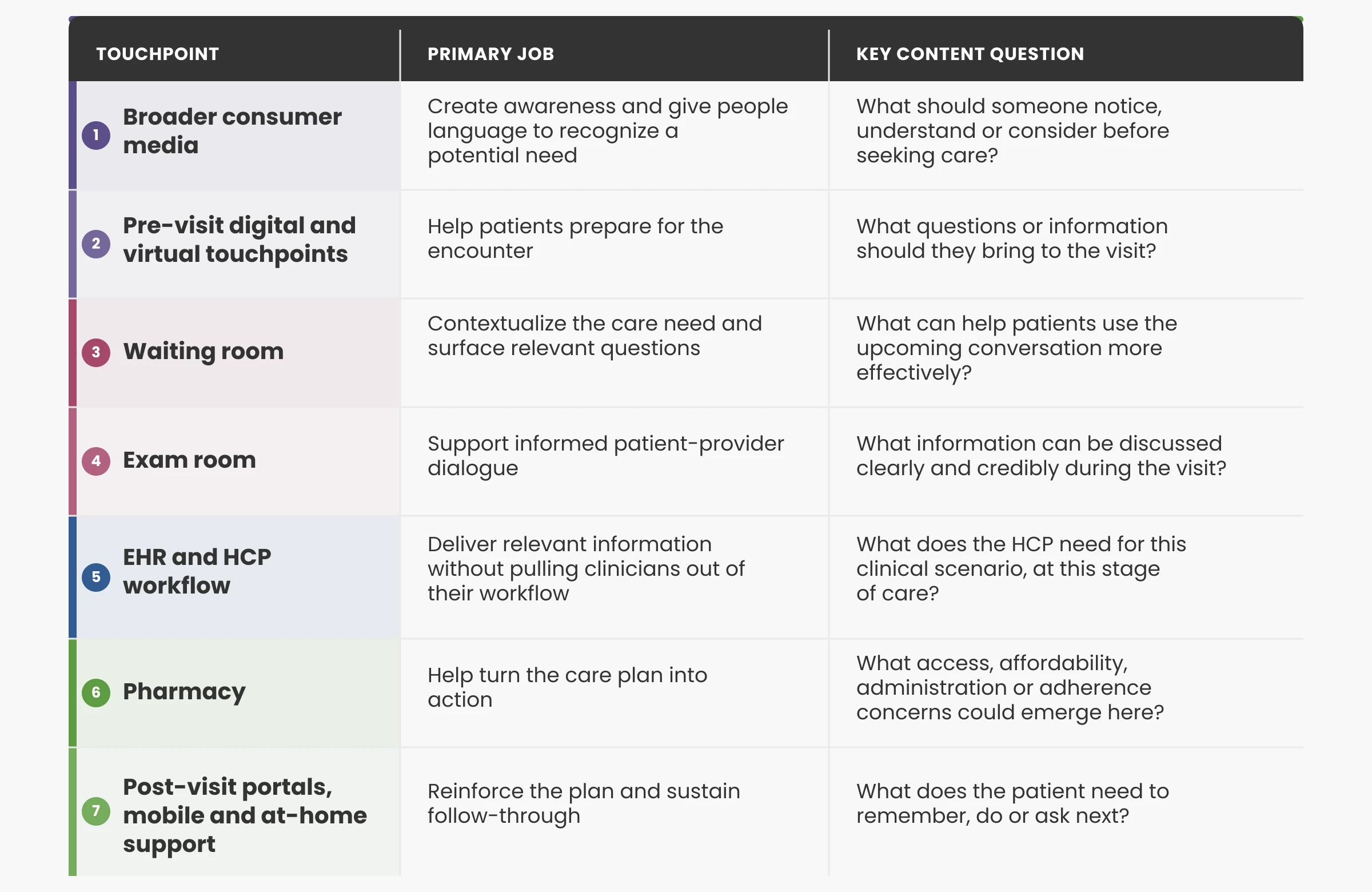
The best integrated campaigns use consistent facts, positioning and tone, but each placement performs a different job. A social video or TV spot, waiting-room screen, EHR message and pharmacy resource shouldn’t just repeat the same headline.
Instead, the message should advance with the journey:
- Broad-reach media introduces the health need.
- Pre-visit media helps the patient prepare.
- Waiting-room content makes the need more personally relevant.
- Exam-room and EHR resources support the conversation.
- Pharmacy communication addresses initiation and access.
- Post-visit content reinforces the agreed-upon next steps.
POCMA’s POC Product Finder can help marketers identify solutions by audience, specialty, setting and tactic. But it’s most useful after the strategic jobs we discussed above have been assigned. A tactic should be selected because its environment and capabilities match an identified need.
The same principle applies within specialized channels such as the EHR. POCMA’s guide to effective EHR marketing recommends evaluating which providers a partner can reach, where the message will appear within the workflow and which targeting criteria can be supported. The right EHR placement should reach the appropriate HCP with relevant information in a useful workflow context.
Step 5: What Would Success Look Like?
Planning from the moment of care back also requires measuring from the intended outcome back.
If the campaign is designed to prepare patients for a conversation, impressions alone cannot indicate whether it succeeded. If its role is to address a barrier after a prescription is written, general engagement metrics won’t tell the full story.
Before activating your media plan, define a chain of measurement:
- Delivery: Did the campaign reach the intended audience in the intended setting?
- Engagement or learning: Did people notice, access or understand the information?
- Action: Did the campaign prompt a question, conversation, resource request or next step?
- Business or care-related outcome: Was there a change in treatment initiation, prescription filling, adherence, persistence or another appropriately defined outcome?
Not every campaign will be able to measure every stage. The purpose of the framework is to establish what matters before activation, so the team can choose partners, study designs and data sources accordingly.
POCMA’s guidance on measuring Point of Care marketing’s true impact recommends beginning with three questions:
- What are the brand’s marketing objectives?
- What campaign-specific goals is POC responsible for delivering?
- Which metrics and measurement solutions best represent those goals?
Answering those questions early may affect the entire activation plan. It can influence audience construction, control-group requirements, minimum sample sizes, partner selection, data agreements and campaign timing. Measurement is therefore not the final step in activation. It is the final question in the planning framework—and one that should be answered before tactics are actually purchased.
A Better Media Plan Begins With Asking Better Questions
Planning from the moment of care back makes the media plan more coherent. It allows marketers to start with the decision, map the people around it, understand what they need to be successful, build the connections and then define the outcome before selecting the media.
Explore The 2027 Blueprint: Building High-Impact Point of Care Media Plans and use POCMA’s POC Product Finder to identify partners and solutions aligned with your planning objectives.