
Point of Care (POC) media is a growing channel in modern healthcare marketing because it delivers credible information where patients and providers make care decisions. As pharmaceutical marketers continue to invest more heavily in POC media (investment in the POC channel surpassed $1 billion annually in 2024), there’s a need for a standardized, measurement approach to support this increased investment in POC¹.
With rising investments, new technologies, and evolving patient expectations, commercial teams demand accurate, evidence-based measurement of POC’s impact on business outcomes such as prescription volumes and new patient activations. However, measurement is complex, requiring alignment across multiple factors like brand outcomes, patient visit dynamics, office-level placements, halo effects, and overlap with other marketing tactics.
A previous POCMA white paper—Is Your Point of Care Marketing Campaign Measurement On Point? —highlighted persistent challenges in how POC campaigns are measured. The most important: many models still fail to reflect the true reach of in-office campaigns.
This post will walk you through the findings from our latest whitepaper, which provides a new framework to consider for more precise POC measurement.
Make Sure Your POC Measurement Is Meeting the Mark
To measure your POC campaigns effectively and consistently, start with a framework that aligns what’s measured with the brand and business outcomes your campaign aims to achieve. This approach must address three essential questions:
- What are the brand’s marketing objectives?
- What campaign-specific goals is the POC tasked to deliver?
- What metrics best represent these goals, and which measurement solutions can accurately quantify them?
By answering these questions, you ensure that your measurement plan aligns with your business outcomes.
There are multiple ways to measure POC – two common measurement techniques include: Test vs. Control and Marketing Mix Models (MMMs) to determine campaign performance. While Test vs. Control studies are the preferred way to measure POC, MMMs are helpful to determine cross-channel impact and widely used across the industry. We’ll focus below on how to improve MMMs to better reflect POC’s impact. The implications are better media placements and hyper-targeting of the POC promotions to become more effective and more efficient.
The Challenge With Current MMMs
While there’s strong evidence already that POC campaigns deliver meaningful outcomes for brands even with current measurement techniques, many MMMs struggle to capture the true impact of POC marketing.
Legacy models often treat POC presence as a binary “on/off” variable, that, for example, treats a small practice seeing 65 patients per day the same as a large practice seeing 250+. This measurement practice focuses on breadth of POC activity, assuming all HCP offices are equal, ignoring the patient depth differences across offices.
Over time, this oversimplification creates systematic bias: high-traffic POC environments are dramatically undervalued while low-traffic ones are overvalued, leading to misallocated budgets and eroded confidence in POC as a channel.
Reducing POC to binary presence obscures its true contribution—the same issue that arises with any media channel measured this simplistically. Patient-centric POC inputs elevate POC analysis to match other channels that have long used audience-centric approaches in MMM.
For example, TV MMMs typically use GRPs (Gross Rating Points)—an audience reach-based metric that weights each TV campaign by the estimated proportion of the total audience it reaches. Google research on MMM best practices highlights the importance of including the most granular data in models, and highlights audience reach as a key element of that granularity.
Results from MMMs that fail to take into account patient traffic data also can be misaligned with those from Test vs. Control studies, creating discrepancies that erode certainty and clarity.
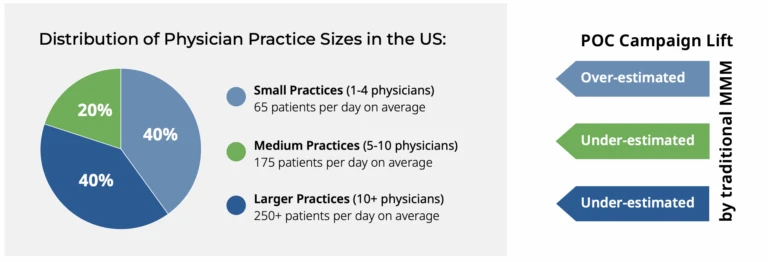
Because only a small fraction of marketers attempt to factor variables like patient traffic into their inputs, there’s an industry-wide opportunity to improve accuracy and relevance in POC measurement.
“The priority to improving POC performance in MMM is to improve the inputs. This means moving from HCP counts to a patient-based input metric that truly reflects the variability and scale of the exposures.”

Eric Talbot Chief Data & Analytics Officer, CheckedUp
The Path Forward: Moving Beyond Binary Inputs for More Accurate Measurement
MedFuse, a company supplying and analyzing real-world data, partnered with Trinity, a strategic, tech-enabled commercialization company that empowers pharma, biotech and medtech to advance the development, launch, and optimization of new medical innovations, to test Syneractiv’s patient-centric input metric called the Patient Reach Index to address this systemic bias in POC measurement.T he Patient Reach Index addresses patient footprint bias by estimating both the breadth of POC activity across all HCPs in the MMM and the qualified patient reach for POC campaign HCPs.
They shared their findings in a new study called Unlocking Point of Care Marketing’s True Impact with Patient-Centric Measurement. In a rigorous comparison against traditional binary models, the Patient Reach Index demonstrated a 4.4x higher POC campaign lift estimate. Most importantly, the Patient Reach Index aligned closely with an independent Test vs. Control study.
This shift toward patient-centric measurement also aligns with broader trends across the healthcare ecosystem. Real-world data, social determinants of health and behavioral analytics are increasingly shaping brand strategies. When applied to POC, these same principles allow marketers to evaluate not just how many patients were reached, but whether the right patients were reached—those most likely to benefit from engagement at that specific moment of care.
Using patient-level metrics makes it possible to understand which specialties or care settings produce the most meaningful engagement. Each metric examined contributes differently to overall campaign performance and accurate inputs reveal those distinctions.
With this improved measurement approach, pharma marketers can achieve greater confidence in POC investment decisions, optimize budget allocation to high-performing HCP segments, and transform MMM from a retrospective scorecard into a forward-looking strategic planning tool.
Plus, this new approach reinforces what we’ve long suspected: that POC’s impact extends far beyond surface-level exposure. POC media influences how patients and healthcare providers learn, how they engage with providers and how they follow through with care.
Take These 3 Actions to Apply The Patient Reach Index in Real Life Today
The Patient Research Index makes clear that patient exposure intensity—not just presence—drives measurable impact. But how do you take the Patient Research Index and apply it to your ongoing measurement program? We’d recommend taking the following steps:
Demand Better POC Inputs
Encourage your internal or external MMM partners to replace binary POC-presence flags with patient-centric metrics that yield more accurate estimates of POC impact. Specifically:
- Supplement MMM inputs with patient traffic
- Avoid relying solely on binary flags for microtargeted media
- Segment by HCP volume tiers to improve sensitivity in lift estimation
Many measurement models also aggregate data by Designated Market Area (DMA), masking local variation.
“Measurement models at aggregated geographies like DMA can dilute the impact at specific locations,” Talbot notes.
When test vs. control methods are used, sample size also becomes a limiting factor. Talbot adds, “When using a test vs control approach there can also be challenges. With this approach it is important to consider sample size of both the campaign and control universe…Methodology and model limitation can prevent markets from getting a clean read on performance.”
These challenges are not unique to POC, but they can be amplified by the channel’s precision. Because POC campaigns operate in tightly defined spaces, a single variable—like practice size or specialty—can dramatically influence results. Using more granular inputs helps control for those variables, enabling cleaner comparisons between test and control groups.
Align Your Measurement Methods
Measurement challenges are often due to quality and not volume of data—often a result of oversimplified or inconsistent definitions.
More effective measurement requires alignment between brands, agencies, data providers and publishers. When stakeholders agree on shared standards for engagement, exposure and outcomes, measurement becomes more accurate.
Standardization enables benchmarking, comparability and continuous learning across campaigns—ultimately accelerating innovation.
Without consistent measurement frameworks and standardization, even the strongest data can produce fragmented insights. Each stakeholder might measure impact differently, using separate criteria for success. This makes it difficult for brand leaders to compare channels or allocate investment effectively. It’s critical to align your POC measurement methods, ensuring consistency between MMM and Test vs. Control studies, reconciling conflicting metrics and recommendations to eliminate stakeholder confusion and build confidence in results.
Make Measurement Prescriptive
Transform MMM from a retrospective scorecard into a forward-looking planning tool that optimizes POC budget allocation across high-performing HCP tiers and identifies the most impactful campaign placements. Use the granular insights from patient-centric models to inform strategic decisions about where and how to deploy POC resources.
Looking Ahead: Help Us Build a Patient-First Measurement Future
These results, though compelling, are based on a single brand study. More generalized learning is needed that covers a range of therapeutic areas and brand life stages. MedFuse is partnering with POCMA to launch a consortium study across POCMA members and their partners to do exactly that.
“The Patient Reach Index represents a new input that shows promise for how brands should measure Point of Care within a MMM,” says Nicole Divinagracia, POCMA’s President. “These initial results are compelling, and we’re now seeking additional brands to help validate this methodology by participating in a consortium study. We encourage any brands running Point of Care media to join this study by completing this inquiry form.”
With an improved approach for measuring POC marketing impact, organizations can achieve greater confidence in decision making for investment and resource allocation.
¹This analysis is based on voluntary revenue reporting from POCMA member organizations. Revenue data was requested from 25 member organizations (POC media companies), where 23 members provided responses.