Reach and Relevance Do Different Jobs: Complementing Mass Awareness with POC Investment
BlogsTuesday Aug 25, 2026
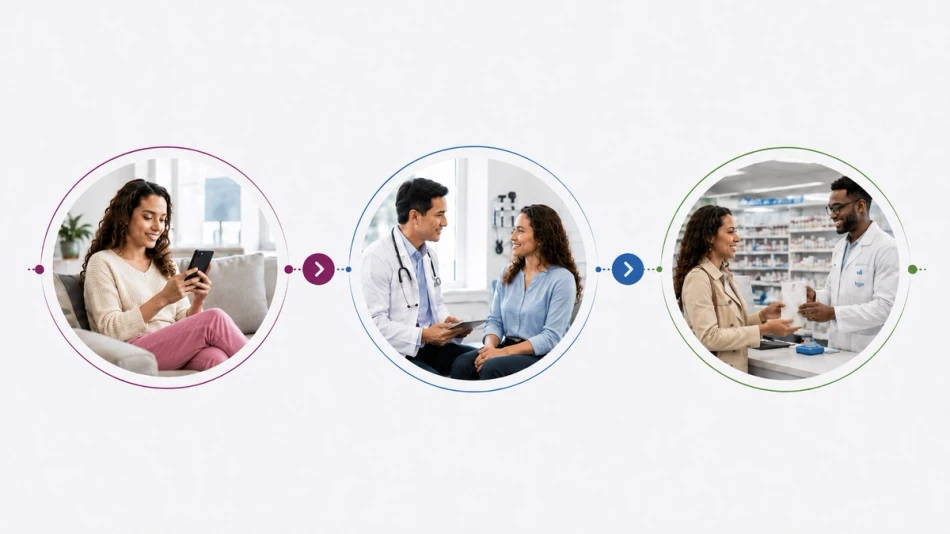
Healthcare marketers face a familiar tension when building media plans: Do we prioritize reach or relevance?
On one side are broad-reach channels designed to put a condition, treatment or brand in front of mass audiences. Think television, connected TV, online video, social and other consumer media that can build familiarity well before a patient ever steps into a healthcare setting.
On the other are highly context-driven channels like Point of Care (POC), where brands can engage patients, caregivers and healthcare professionals (HCPs) around actual moments of care.
It can be tempting to frame the choice as an either/or proposition, especially with finite budgets. But that framing misses the bigger opportunity.
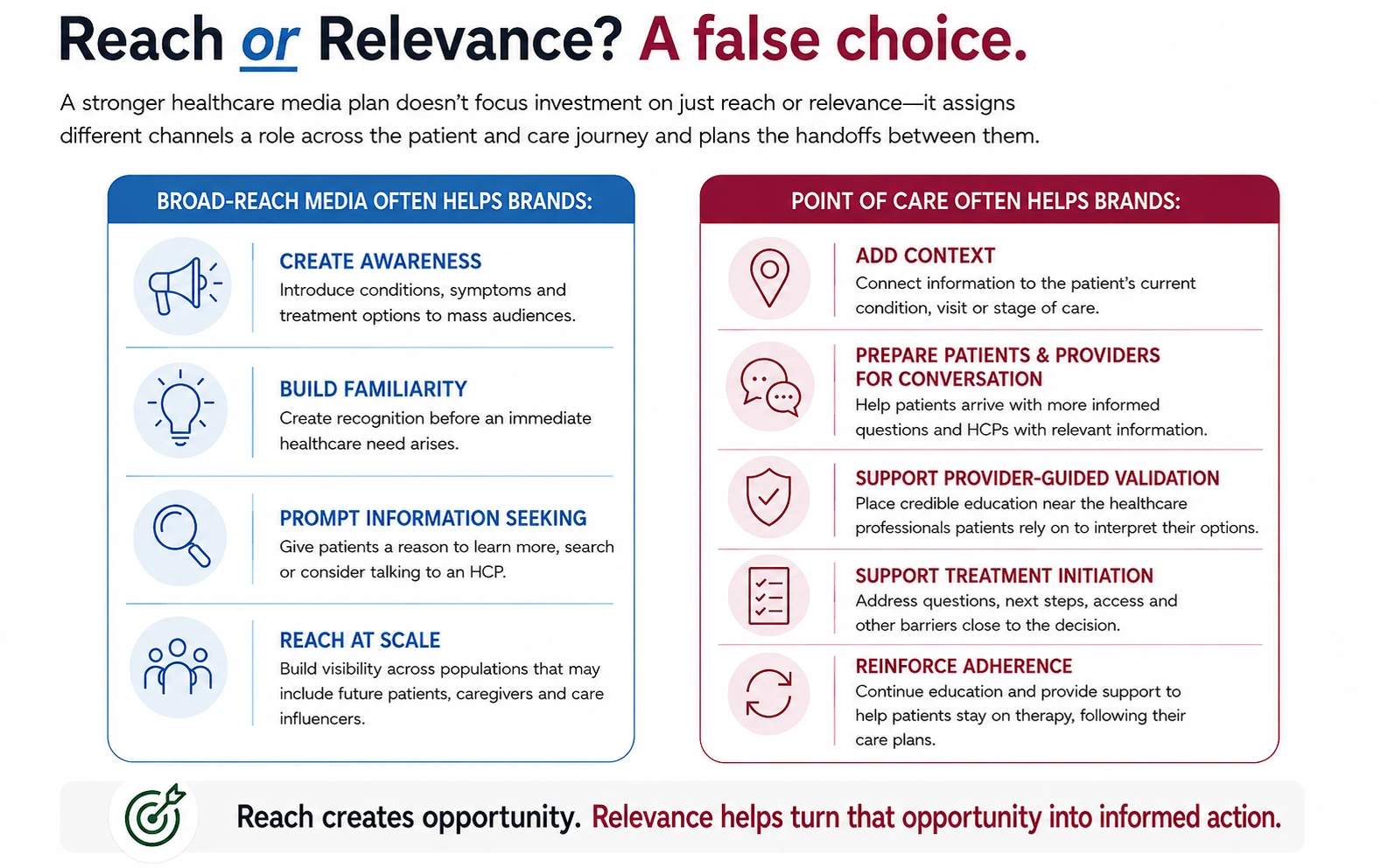
Reach and relevance do different jobs. Strong healthcare media plans understand what each channel is designed to accomplish—and they connect those jobs across the patient journey.
Broad Reach Still Has an Important Job to Do
Before making our case for relevance at the POC, it's important to be clear that mass awareness is not inherently wasted reach. Broad-reach media can play a role in creating familiarity with a health condition or treatment before an immediate need arises.
A recent JAMA Health Forum review of the evidence around direct-to-consumer pharmaceutical advertising notes that research has associated DTC advertising with increased patient information seeking, treatment initiation and medication adherence. The research reinforces a key point for marketers: advertising can create behaviors that extend beyond immediate brand conversion, including encouraging people to learn more about their health.
M3 MI's research provides a picture of what happens next. According to POCMA's analysis of the 2026 MARS Consumer Health Study, 61% of U.S. adults go online for health and wellness purposes at least weekly, and 57% research treatment options on their own before asking their doctor about them, a reminder that the journey does not begin when a patient arrives for care.
Reach creates opportunities for your brand to be considered by your target audience. But consideration is not the same thing as a decision.
Relevance Becomes More Important as the Decision Gets Closer
As patients move closer to making decisions about their care, the job of your advertising changes.
Your message no longer needs only to be noticed or remembered. It needs to be relevant to the patient's situation, credible enough to inform a conversation and useful enough to help someone determine what to do next. That's where POC offers a different kind of value, especially when it comes to trust-building.
The same M3 MI research found that while patients are consuming more health information independently, they remain selective about what they trust. Only 37% said online health and wellness advertising was trustworthy, while just 30% trusted medical information shared by others on social media. At the same time, doctors remained patients' number-one source of health information.
That pattern of trustworthiness in close proximity to care settings is supported beyond M3 MI’s research.
In 2026, Pew Research Center surveyed more than 5,000 U.S. adults about where they get health information. 85% said they get health information from healthcare providers at least sometimes—more than any of the other sources Pew studied. Among people who use healthcare providers as a source, 65% rated the information they receive as extremely or very accurate. By comparison, only 7% of people who get health information from social media rated that information as highly accurate.
That credibility, trust and accuracy at the POC changes the comms opportunity for marketers.
At the POC, the patient isn’t just a potential future consumer as they could be on broad reach channels. They may be sitting in a waiting room preparing for a conversation, reviewing information in an exam room or via a telehealth platform, talking with a physician about options, filling a prescription at a pharmacy or navigating follow-up support after a visit.
The context itself creates the relevance that broad reach often misses.
And according to M3 MI's 2026 research, patients recognize that value: 90% consider Point of Care materials valuable sources of health information.
The Strategic Unlock: The Most Powerful Media Plans Connect Reach to Relevance
Here’s a scenario where broad reach and credibility at the POC converge to drive an outcome: Imagine a patient who sees a television spot about a condition they have been managing. That exposure makes the issue more familiar. Later, they search the condition online and learn about available treatments. When they arrive at their physician's office, an educational POC placement addresses a question they have been considering, perhaps clarifies some misinformation they were exposed to during their research phase and prompts them to raise the topic during their appointment.
Each exposure contributed something different.
One created awareness. One allowed exploration. One made that information relevant to an immediate healthcare conversation.
Cross-channel measurement research from Veeva Crossix makes an equally important point: no channel should automatically be expected to do every job well or in a vacuum.
In one multichannel campaign, Veeva Crossix measured patient exposure across TV, digital and POC and found substantial differences in scale, efficiency and impact by channel and channel combination. Exposure across all three channels produced twice the impact of digital alone and three times that of TV alone. Veeva Crossix concluded that measuring how channels work together offered a more useful picture than evaluating each in isolation.
In another specialty pharmaceutical case highlighted in POCMA's Changing Healthcare Landscape report, POC represented 14% of media investment but was attributed with 35% of new patient starts. Again, that is a single campaign—not a benchmark brands should universally expect. But what it illustrates is that share of spend and strategic contribution do not necessarily move in lockstep. As Kelli Diveley has put it:
Point of Care is a critical, strategic component of our media mix.

Kelli Diveley
Senior Director of Integrated Media Strategy – Primary Care
Pfizer
Component is the important word. The goal is not to make every channel POC, rather to give POC the role it is best equipped to play within a broader strategy.
The Job Continues After the Prescription Is Written
There is another reason marketers should resist thinking about the media mix as a simple awareness-to-conversion funnel: the patient journey continues after treatment is prescribed. Initiation is the first step, but adherence is another critical goal.
M3 MI's 2025 MARS Consumer Health Study found that two out of three patients have chosen not to fill or refill a prescription at least once. The reasons and support needs differ by generation, from affordability information to access to human or digital assistance.
That creates another job for media. POC can extend from the provider's office into the pharmacy and post-visit environment, where communications can reinforce treatment instructions, clarify affordability resources, answer practical questions and support follow-through.
M3 MI's recent research found that among patients who noticed healthcare advertising in a doctor's office or pharmacy, 75% filled a prescription or took medication as prescribed, while 37% received a new prescription or switched medications. These are reported behaviors among exposed patients, not causal lift estimates, but they demonstrate that the actions taking place around POC extend well beyond awareness.
This is why POC should not be reduced to a bottom of funnel channel, either. The job to be done for POC media changes with the moment in the patient journey.
Different Jobs Require Different Measures of Success
If channels are doing different jobs, marketers should not automatically evaluate all of them against the same metric.
A broad-awareness investment might reasonably be evaluated against reach, frequency, audience quality, brand awareness, search behavior or other indicators of whether the campaign is creating familiarity and interest. As the patient moves closer to care, marketers can begin looking for signals tied more directly to healthcare behavior.
POCMA's 2027 Blueprint for Building High-Impact Point of Care Media Plans recommends aligning POC measurement to the specific campaign objective and considering outcomes such as prescription lift, treatment initiation, adherence and patient activation.
That does not make one set of metrics better than another, but it does mean that measurement should reflect the job a channel was assigned.
If the purpose of television is to build broad condition awareness, judging it only on immediate prescription starts may understate the role it plays upstream. Similarly, if the purpose of a POC activation is to reach clinically relevant patients preparing for a provider conversation, reporting only impressions may understate the role it plays downstream.
And if the strategy depends on multiple channels working together, measuring them only in isolation may obscure the handoffs that ultimately contribute to patient action—exactly the challenge identified in the Veeva Crossix multichannel case study.
The measurement plan should therefore begin with the same question as the media plan: What job are we asking this investment to do?
Planning for the Journey
Healthcare marketers don’t need to choose between scale and specificity. Instead they need to understand when each matters.
POCMA's Changing Healthcare Landscape and the Rise of POC Marketing describes this evolved thinking as a shift toward interconnected marketing: rather than merely placing consistent messages across separate touchpoints, marketers have an opportunity to link those touchpoints around the changing needs of the patient.
That's the mindset we believe marketers should carry into planning. Instead of asking: Should we invest in reach or relevance? Ask: Where does our audience need reach—and where do they need relevance?
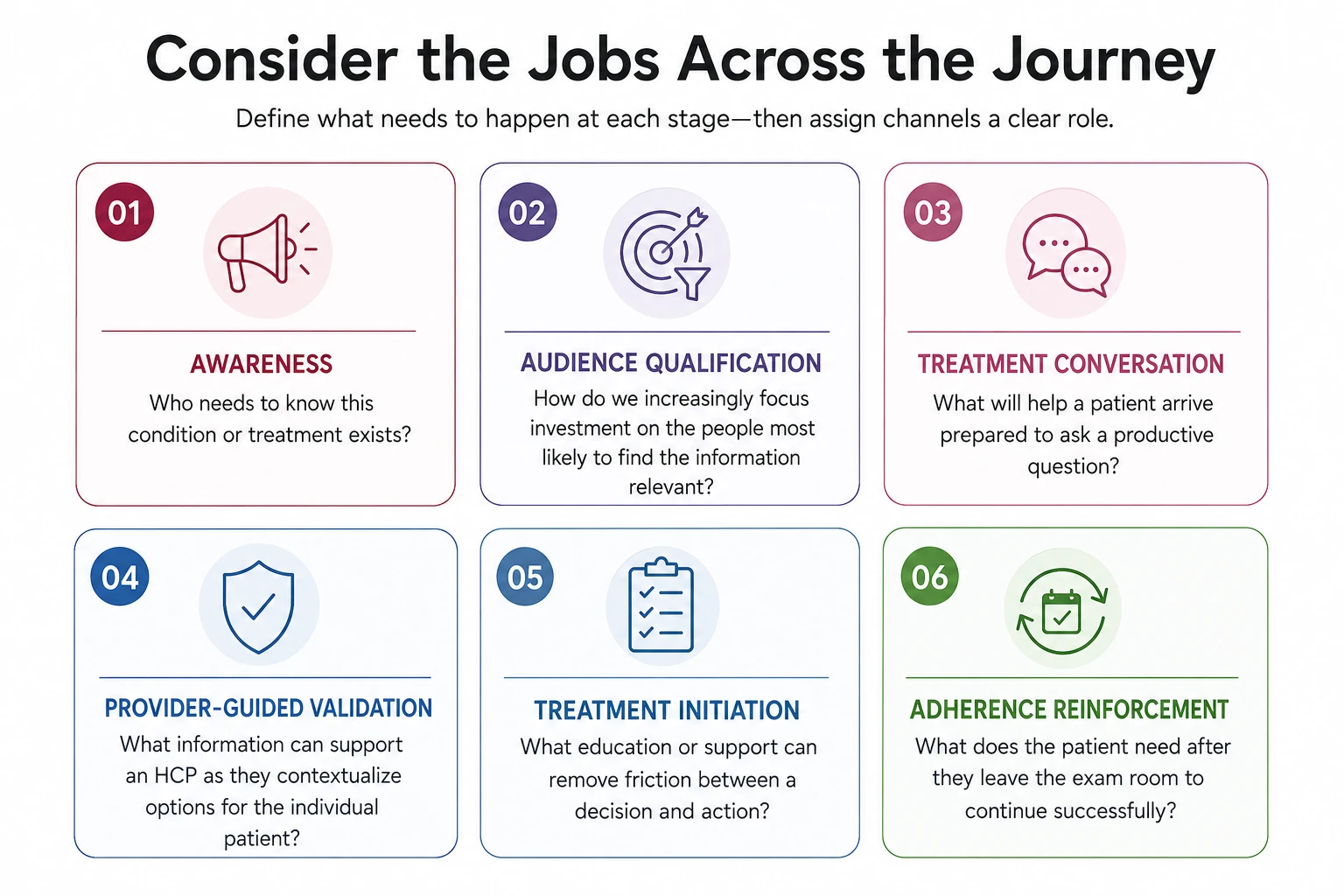
The strongest media plan is not necessarily the one that maximizes reach or the one that maximizes precision. It's the one that understands what each channel is uniquely positioned to accomplish, then connects those jobs into one patient journey.