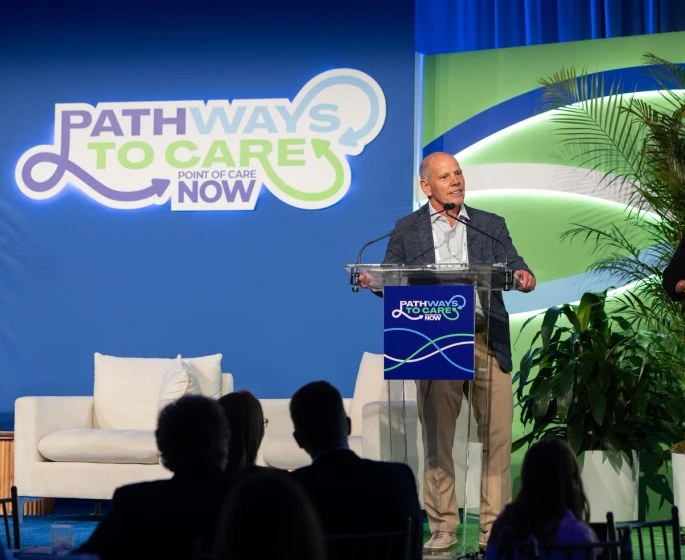
At the POC Now Summit in March, we announced the recipient of the 2026 Lifetime Achievement Award. POCMA reserves this prestigious accolade for an individual whose career has made extraordinary, lasting contributions to Point of Care (POC) marketing. The criteria for this award are stringent: recipients must have demonstrated a transformative impact, sustained leadership and mentorship, pioneering innovation, and a lasting influence on industry standards and best practices. It’s not merely an acknowledgment of longevity; it is a celebration of profound, industry-defining influence that advances and professionalizes the entire POC field.
There’s perhaps no one who embodies these qualities more fully than Mike Collette, the Founder and Former Chairman of PatientPoint. Widely recognized by his peers as one of the pioneers of the POC media, Mike is often affectionately regarded as the "Godfather" of Point of Care.
Over the course of nearly four decades, Mike’s visionary leadership helped transform the POC channel from its initial offering of simple print-based health education materials into an offering that spans print and digital media across many different surfaces, placements and spaces.
We recently had the opportunity to sit down with Mike for an in-depth conversation about his remarkable career, the evolution of the POC landscape, and his enduring passion for the industry. Here are some of our takeaways.
The Genesis of an Industry: Building from the Ground Up
To understand the impact of Mike’s career, we have to first rewind to a time where the media landscape looked vastly different from what it does today. Mike’s professional journey began in Cincinnati, Ohio, where he took his first job out of college working in the health and personal care division at Procter & Gamble. The year was 1987, and the marketing world was remarkably constrained compared to today’s omni-channel reality. As Mike recalls, "There were only four media channels at that time - this is well before the digital age. You had TV, print, radio and outdoor."
During his tenure at P&G, Mike and his colleagues began to notice a new, emerging channel that a few ambitious entrepreneurs were dabbling in called "place-based media." The concept was simple but powerful: creating a custom media channel designed to reach a specific target audience at the ideal moment.
However, the execution left much to be desired. Of note, Mike observed the exorbitant prices vendors were charging for these early placements. Performance measurement was also shaky at best. His reaction was swift and decisive: “We could do it a lot better," he recalled.
This crucial insight sparked a massive leap of faith. Driven by the belief that he could build a more effective model for the burgeoning placed-based media industry, Mike took the ultimate entrepreneurial risk. He cashed in a life insurance policy, maxed out a credit card, and left the security of P&G to launch his own venture, originally called On Target Media. Two of his colleagues from P&G eventually joined him in his new venture, too.
The company’s inaugural efforts laid the groundwork for the modern POC industry. Their very first program was designed for Pampers and placed in hospital maternity wards. And this program was closely followed by one for Metamucil placed in gastroenterology offices—a milestone that Mike credits with kickstarting the office-based Point of Care space as we know it today.
Encouraging Patient Education Over Advertising
While the logistical placement of media in doctor's offices was a novel operational feat, Mike’s real innovation was ideological. From the very beginning of his time shaping the industry, he recognized that the core differentiator of POC media had to be its unwavering commitment to patient education rather than simply delivering advertising messages to patients.
Reflecting on this founding insight, Mike explained the critical difference between traditional media channels and Point of Care: "Most media channels are advertising focused. [But] serving content at the Point of Care channel was really [focused on] patient education."
This distinction informed how Mike built his company. He and his team realized that they were fundamentally in the patient education business; and that corporate sponsorship was merely a funding strategy that allowed them to fulfill their ultimate mission of empowering better health.
This commitment to education was also essential for overcoming the primary obstacle to POC’s early growth as a channel: hesitation from healthcare providers (HCPs). As Mike noted, the single biggest objection POC companies faced when trying to persuade a provider to accept a program was the presence of advertising. The only way to overcome this friction was by demonstrating a tangible ability to deliver positive health outcomes for the patient.
Over time, tracking claims-level data allowed Mike’s team to prove that their educational programs were moving the needle on critical metrics like colonoscopy screening rates, mammography screening rates, immunization rates, medication adherence, and overall disease state awareness.
The human impact of this educational focus is considerable - Mike shared how these initiatives regularly went beyond marketing metrics to become literal lifesavers. "We'll get letters back from doctors talking about [how we] literally saved [a] patient's life because they had a mole that would have been otherwise deadly had they not brought it to [their] attention," he recounted. Ultimately, this dedication to positive health outcomes is what earned POC media the privilege to exist in trusted healthcare settings.
Beyond PatientPoint: Building Trust with the Founding of POC3 & Driving Health Equity with the PatientPoint Foundation
Mike’s legacy isn’t solely defined by the growth of PatientPoint and the POC channel alone, but by his advocacy for the entire industry as well. He was a driving force behind the creation of higher industry standards, notably co-founding POC3 (which has since evolved into the Point of Care Marketing Association) to advance transparency and accountability among POC media partners.
The initial goal for the new trade association was building greater awareness and understanding of the POC channel. But under Mike's leadership and in consultation with the broader industry, POC3 shifted its focus toward building trust by establishing rigorous auditing processes and standards in 2017. This collaborative effort bolstered the channel's credibility and gave essential partners trust in POC media. It was a testament to Mike's enduring philosophy—a phrase he was often heard repeating: "all boats rise when the industry grows."
Beyond his commercial successes, Mike has championed philanthropy, education, and mentorship, ensuring that POC tools serve those who might not otherwise have access to them. A cornerstone of this philanthropic work is the PatientPoint Foundation, which was established in response to the murder of George Floyd in May of 2020.
The tragedy deeply shook his company, prompting a period of internal reflection. As Mike articulated about the moments following the murder, "We didn’t want to just make a statement. We wanted to make a difference."
Recognizing their expertise in health education, the team observed a glaring gap: socially vulnerable and underserved communities were frequently absent from the target lists of their pharma clients. Rather than waiting for the market to correct itself, they decided to fund educational programs in these communities themselves.
The Foundation quickly realized that merely providing education was insufficient; they needed to actively build trust, too. This led to the hiring of community-based "health ambassadors"—individuals from within the communities who understand the nuance of the communities they serve and have established relationships within them.
These ambassadors facilitate challenging health conversations and connect residents to physicians for baseline screenings, ensuring that previously undiagnosed disease states can be identified and treated. Today, the Foundation continues to grow, garnering support from pharma partners to make a meaningful, localized impact on health equity.
Mike’s Advice: Take the "Exam Room Back" Approach When Media Planning
Despite the proven efficacy of POC, with growth projected to exceed $1.2 billion in 2025 revenue among reporting POCMA members, Mike believes that the broader ads and pharmaceutical industries still sometimes underestimate the strategic power of POC media. All too often, he asserts, brands, agencies and marketers view Point of Care strictly as a bottom-funnel tactic—a convenient way to deliver a final reminder message moments before a patient engages with their physician. While Mike acknowledges that POC is exceptionally effective in this regard, he argues that limiting its role to the bottom of the funnel misses its critical strategic importance.
To illustrate this point, Mike draws on a powerful piece of advice on how to approach healthcare advertising and media planning that he learned from his longtime friend and early client, Pfizer’s Glenn Roginski. Their shared philosophy is simple: "build your media plan from the provider’s office, or more specifically, the exam room back."
Mike compares this media planning mindset to the long-standing mantra of the Path to Purchase Institute in the consumer marketing world, which urges brands to "build your media plan from the store shelf back." For healthcare and pharma marketers, the exam room is the ultimate "shelf"—the magic moment where patients and providers make vital, life-altering care decisions.
And because healthcare decisions are rarely instantaneous and often require a process of consideration, early and trusted education at the POC is essential for guiding patients and providers toward a decision. By starting media planning at the POC and building backward, marketers can ensure their strategies are fundamentally aligned with the realities of the patient journey and with how providers deliver care.
The Power of Love and Trust in Business
When asked to share advice for the next generation of leaders building in the Point of Care space, Mike highlighted two foundational elements that have guided his career: culture and trust.
He described the culture at PatientPoint as a "gravitational force"—an intangible quality that draws people in and keeps them committed. Upon deep reflection, Mike identified the core of this culture with a word rarely seen in corporate mission statements: love. He explained, "One of the last things that I did as a CEO before I left was [making] one of our core values [love]." While acknowledging the initial skepticism of using such a word in business, Mike firmly believes that centering love differentiates PatientPoint and remains a vital part of what makes PatientPoint special.
Equally important is his perspective on corporate and personal integrity. He frequently counsels students and young professionals on the fragility of reputation. "It takes years to build trust. But it can be easily lost in a moment if you put profit above principle," he warned. Drawing upon stories of past industry fallouts and scandals, he urges emerging leaders to be fiercely protective of their personal brands and moral compasses, noting that poor decisions can destroy a reputation overnight.
Looking Forward: Personalization and Programmatic
As Mike looks to the future of the POC industry, he sees massive opportunities on the horizon. For companies looking to drive meaningful impact, his advice boils down to one primary word: “personalization”. The ability to leverage software and AI to deliver tailored, specific content is what he views as the "holy grail" for the next generation of POC media.
Mike believes the industry must lean heavily into product innovation. He envisions a future focused on "developing personalized 1:1 messages that are highly relevant [and] targeted to each specific patient." By mastering this level of customized engagement, Mike anticipates the already impressive ROI of the Point of Care channel will grow exponentially.
Additionally, to reach its full potential, Mike believes the industry must embrace programmatic buying to make the channel easier to navigate. Just as programmatic buying facilitated the explosion of other digital media channels, applying similar technological ease to POC will allow marketers to seamlessly buy across different companies, thereby maximizing reach and overall business impact.
A Well-Deserved Honor
Receiving the Lifetime Achievement Award in his retirement proved to be a deeply emotional and meaningful experience for Mike. Standing on the stage at the POC Now Summit, looking out at an audience filled with early clients and colleagues from over thirty years, he shared that he found a profound sense of closure and gratitude. It was a powerful affirmation that his decades of relentless dedication to the POC channel and to the people who supported him along the way had not been forgotten.
Despite stepping back from day-to-day operations, Mike’s passion for POC remains undiminished. He continues to view the channel as entirely unique in its ability to positively impact human lives. And he remains a steadfast cheerleader and champion for the industry, driven by the enduring belief that as the POC community collectively grows, so too does its capacity to impact and improve patient lives.
We at POCMA are profoundly honored to celebrate his legacy, his leadership, and his enduring contributions to healthcare engagement.