
During planning season, healthcare marketers define brand strategy and align on healthcare provider (HCP) and patient audiences. Then they finalize HCP and direct-to-consumer (DTC) budgets, align on channel budget allocations, determine appropriate messaging, and align on overall performance measurement before going to market.
But historically, media planning efforts in healthcare have optimized for channels that have historically yielded the highest ROI - think broadcast TV or paid search, for example - rather than looking at the breadth of channels that can help reach HCPs or patients throughout their entire decision-making journey.
This approach begs an important question - what are healthcare marketers leaving on the table by planning with only some channels in mind, and leaving the rest to adapt to a narrow, “nice-to-have” strategy?
We believe there’s a better way to reorient the planning process - by building around where the entire patient journey resolves at the Point of Care (POC).
Longtime POC pioneer Mike Collette calls this approach “build[ing] your media plan from the provider's office.” More specifically, the philosophy is to build the plan from the exam room back.
The analogy comes from shopper marketing's practice of planning from the store shelf backward. In healthcare, the exam room represents a comparable decision environment—the place where broader awareness and consideration ultimately meet a real discussion about care.
That of course doesn't mean every patient journey begins or ends in the exam room. Today's Point of Care ecosystem is far more expansive, spanning physical and digital interactions before, during and after a healthcare encounter. But the philosophy offers marketers a useful shift in perspective.
And heeding it means marketers won’t start by asking: “Which POC tactics can we add?” But instead will begin with: “What should happen at the Point of Care—and how should that shape everything we build around it?”
That is how POC moves from a line item added to the plan to a strategic input that can help make the entire plan stronger.
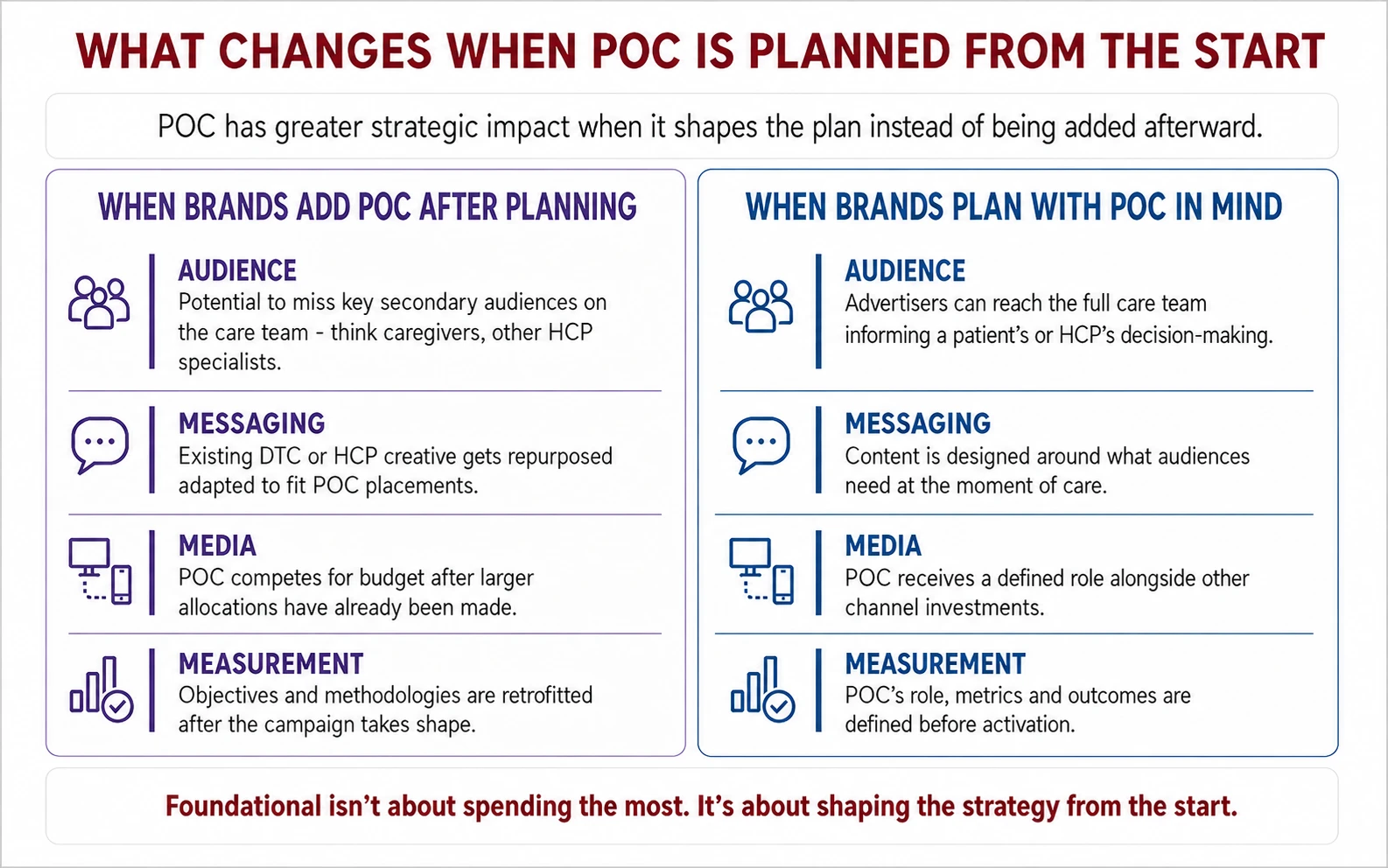
When marketers bring POC in earlier in a product’s lifecycle, four things can change: who they reach, what they say, how their channels work together and how they measure success.
Planning Should Start With the Moment Where Healthcare Decisions Happen
The patient-provider interaction is more than another media touchpoint. It is a fundamentally different information environment that commands greater attention from audiences and ultimately drives better outcomes.
Recent M3 MI research helps explain why those moments deserve marketers' attention. Simply put - other media channels are failing the credibility test - and do little to educate and drive consensus as a result. POCMA's analysis of the 2026 MARS Consumer Health and Professional Health findings found that only 37% of patients said health and wellness advertising online was trustworthy, while 30% trusted medical information shared by other people on social media.
But patients look to healthcare professionals to help make sense of the information they receive from these other channels. In the same research, doctors ranked as patients' top source of health information.
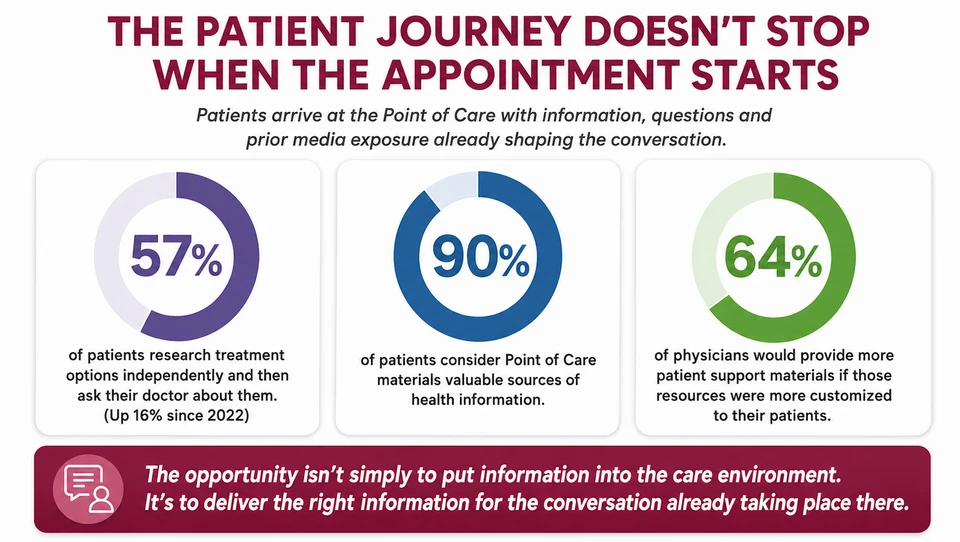
Source: M3 MI MARS Consumer Health and Professional Health research, as reported in POCMA's The Power of Point of Care: 2026 Patient and Provider Engagement Trends Shaping Healthcare Messaging.
This is the strategic importance of the care moment: information gathered elsewhere meets credible, clinical expertise at the POC. And if you’re not considering what will happen once your patient or HCP arrives in a clinical setting and how your brand can inform that interaction at the start of your media plan, you’re missing a key piece of the puzzle.
Planning POC Earlier Changes Who You Target
Perhaps the clearest example of what changes when POC moves upstream is audience strategy.
Planning POC earlier gives marketers time to examine the full care journey and identify which healthcare professionals and care-team members influence decisions along the way. Rather than defaulting to top-decile prescribers or traditional target lists, marketers can explore a broader set of audiences based on their actual roles in care delivery.
We know that modern care delivery is deeply collaborative. That means considering the full care team—including nurses, pharmacists and caregivers—instead of focusing exclusively on physicians or presumed prescribers. Otherwise, marketers may overlook people who influence important decisions throughout the patient journey.
We also recommend looking beyond static specialty labels and instead looking toward provider behavior. A melanoma patient's first relevant interaction, for example, may happen in dermatology before oncology enters the journey. A patient with diabetes may interact with podiatrists or optometrists as part of ongoing care, as many health conditions require care across multiple providers and healthcare settings.
There is real-world evidence for challenging the presumed prescriber targeting approach. In a 2024 gastrointestinal campaign, Veradigm expanded a client-supplied NPI target list using first-party EHR data, including ICD-10 diagnosis codes, prescribing behavior and other clinical signals, to identify additional likely prescribers. After the expanded targeting was introduced, total prescriptions increased 40% in August versus July and 95% in September versus July; September prescriptions were 157% higher than the average monthly prescription volume from February through July. These results represent a single campaign rather than a universal benchmark, but they illustrate the potential value of looking beyond a traditional NPI list when relevant clinical data identifies additional prescribing opportunities. See POCMA's full list of POC targeting recommendations here.
Planning POC Earlier Changes the Messaging Strategy
Bringing POC upstream can also change the way a brand communicates.
One of the most obvious symptoms of late-stage POC planning is familiar: creative designed for another environment gets repurposed for Point of Care.
A digital banner becomes an exam-room asset. Consumer creative is resized for the waiting room. HCP content built for another professional environment is moved into a clinical workflow. The brand may remain visually consistent, but the communication has not necessarily been designed for the moment, and could fail to convert as a result.
There is a better question to ask, such as “How do we repurpose this asset for POC?”. Marketers need to ask, “What does this patient or healthcare provider need at this particular moment in the care journey?”
That may mean preparing a patient with one clear question before an appointment. It may mean giving a clinician concise information while they are working inside the EHR. It could mean clarifying affordability resources at the pharmacy or reinforcing instructions after a visit.
The answer will not always resemble creative designed for broad-reach awareness.
This Ipsos research offers useful guidance for how to design POC communications. Providers expressed preferences for concise, digestible formats; content customizable to patient demographics; digital formats that are easy to update; and materials designed for different levels of health literacy.
Planning POC placements earlier gives marketers time to design for those differences rather than retrofit assets after the fact. The objective should not be identical creative everywhere. It should be one coherent strategy expressed appropriately for each audience, setting and moment.
Planning POC Earlier Gives the Channel a Distinct Job
There is another subtle but consequential difference between early and late POC planning.
When the channel enters after budgets have already been allocated, the conversation can become: What funds are available for POC? But when it enters during strategy development, marketers can ask a much more valuable question: What should POC accomplish?
That job will differ by brand, and POC media can complement and connect other parts of your media plan because it’s where many different audiences converge before making a health decision. PatientPoint’s Linda Ruschau made a complementary omnichannel argument, pointing to POC as an environment capable of connecting separately managed patient and HCP strategies, for example.
For one campaign, POC may help turn broad disease awareness into a more informed patient-provider discussion. For another, it may reach healthcare professionals inside clinical workflow. It might support treatment initiation, address access barriers, reinforce adherence or connect patient and HCP messaging across the same appointment journey.
If the budget is not initially set aside for POC, foundational planning may require shifting dollars from television, digital or other channels into POC—but the right allocation will differ by brand and its strategy. This means marketers must allocate budget according to the distinct role each channel should play. The opportunity needs to start with the care journey and determine what each channel investment should accomplish around it.
Planning POC Earlier Changes How You Measure Success
Marketers often discuss measurement as something that happens after a campaign launches. In reality, some of the most important measurement decisions happen before the first impression is ever delivered.
What business objective are we trying to affect? What specific job is POC responsible for? Who is the relevant audience? How will exposure be defined? Which inputs need to be captured? What outcome should the campaign be evaluated against? And how should POC be represented within the brand's broader measurement model?
Those questions become much harder to solve retroactively.
The whitepaper Unlocking Point of Care Marketing's True Impact with Patient-Centric Measurement recommends starting with three questions: (1) what the brand's marketing objectives are, (2) what campaign-specific goals POC has been assigned and (3) which metrics and measurement solutions accurately reflect those goals.
If POC is foundational, marketers should not decide the strategy first and ask analytics teams afterward how to measure whatever was purchased. The campaign needs a defined role early enough for the appropriate audiences, exposures, data and outcomes to be built into both the strategy and measurement framework.
We make the same recommendation in our ten principles for high-impact campaigns: align stakeholders on objectives, KPIs, and measurement plan before launch. Then, connect performance to outcomes such as prescription lift, treatment initiation, adherence or patient activation when appropriate to the campaign objective.
When POC is a foundational part of a brand’s plan, it has a clearly defined job—and provides the opportunity to determine whether it did that job well.
The Real Shift: From “What POC Tactics Can We Add?” to “What Role Should POC Play?”
The growth of Point of Care is already changing healthcare media. Investment in the channel continues to rise, and the ecosystem today stretches across physician offices, hospitals, pharmacies, EHRs, telehealth and other physical and digital environments surrounding interactions with care.
But the larger opportunity is to change when the channel enters strategic planning.
As marketers build their 2027 strategies, here are five questions worth asking before the media plan is locked.
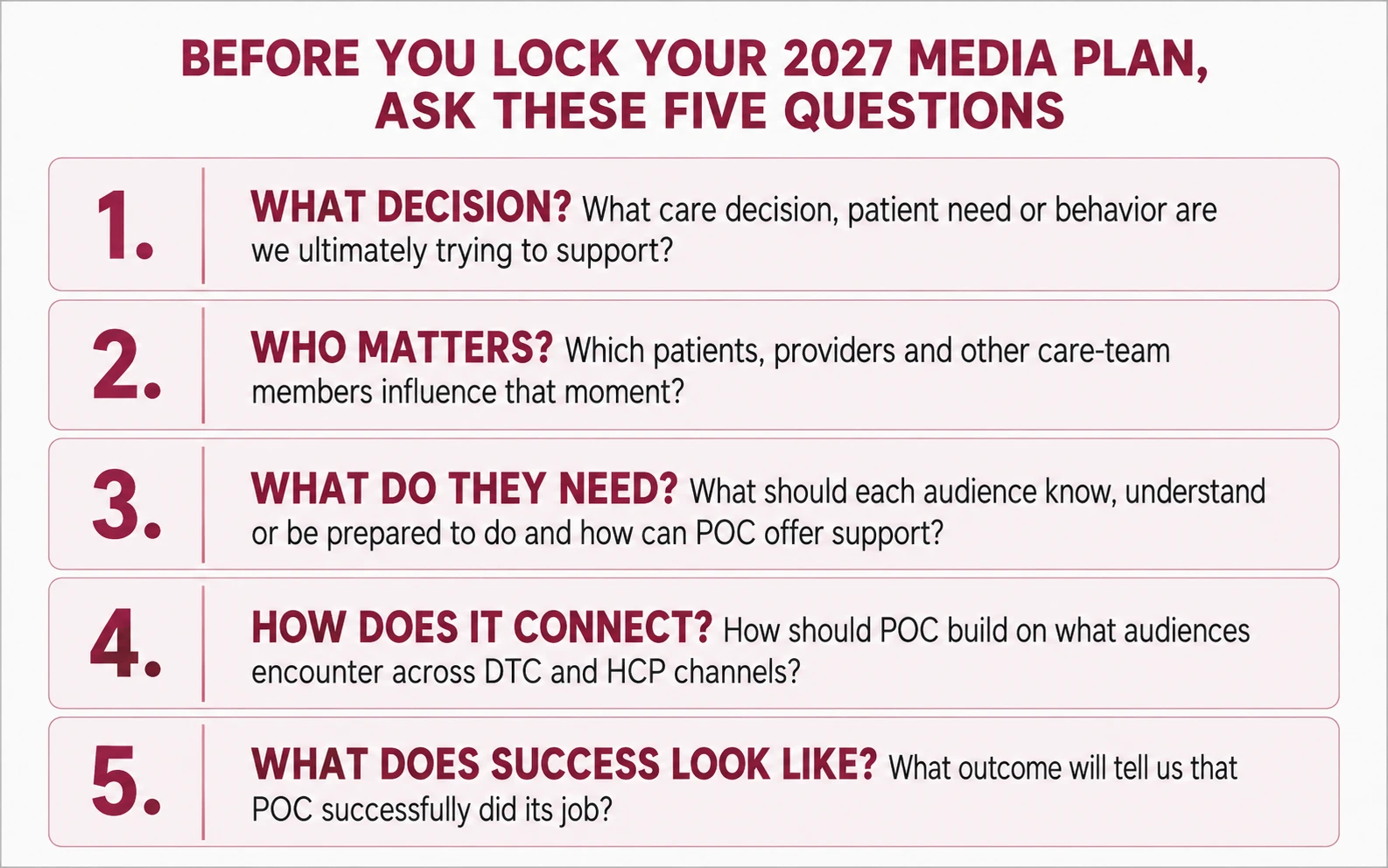
The answers to those five questions will look different for every brand.
POCMA's existing resources can help marketers take the next step. The 2027 Blueprint: Building High-Impact Point of Care Media Plans brings together data-backed planning guidance and ten principles spanning audience strategy, HCP/patient alignment, care-setting selection, creative development and measurement. And POCMA's Product Finder can then help planners explore POC solutions by audience, HCP specialty, care setting and media tactic.
Pulling It All Together: Impact and Outcomes
Why plan POC first? Because timing and relevance drive impact. HCPs face growing pressure to see more patients, while patients and caregivers must navigate an overwhelming amount of information alongside the stress of a diagnosis. A POC-first strategy establishes clear expectations and enables tailored, targeted messaging to reach the right person at the right moment—driving stronger engagement, better performance, and more meaningful outcomes.
Plan backward to move forward.