[New Research] The Power of Point of Care: 2026 Patient and Provider Engagement Trends Shaping Healthcare Messaging
BlogsWednesday Feb 4, 2026

The headline? Patients are arriving at the Point of Care more informed than ever before. But they’re also more overwhelmed. They’re navigating a mix of online information, direct-to-consumer (DTC) advertising, social media, and advice from friends and family, all while trying to make decisions that directly impact their health.
We’ll dig into what these trends mean for pharmaceutical brands and marketers looking to engage patients, caregivers, and providers at the POC in 2026.
Who the Studies Surveyed
The findings in this report are based on the MARS Consumer Health Study, a nationally representative, syndicated research of U.S. adults, and M3 MI’s Professional Health studies of healthcare professionals, which include:
- 20,000 U.S. health consumers and caregivers across 120+ conditions
- 17,700 Physicians across 35+ specialties, PAs/NPs, and other health verticals
This broad sample allowed the research to capture not only what information patients value, but where trust is built—and how HCPs influence and shape engagement with educational materials and messaging.
Patient Engagement Trends and How Point of Care Messaging is Evolving
Patients Are More Informed, But Not Always More Confident
Patients today are more proactive about seeking health information than in the past. Many arrive at appointments having already researched symptoms, conditions, or treatment options.
- 159 million (61%) U.S. adults go online for health and wellness purposes at least once a week, an increase of 17% since 2022
- 57% research treatment options on their own and then ask their doctor about them, up 16% since 2022
- 57% are willing to ask their doctor for a prescription drug sample they saw or heard advertised, up 19% since 2022
Fundamentally, a more informed patient is a good thing. However, being “informed” does not necessarily mean being well-informed.
The research shows that patients often struggle to contextualize what they’ve learned online, separate credible information from misinformation, or understand how generalized content applies to their personal health situation.
- 76% of patients who saw a prescribing physician inthe last 12 months say they are “very cautious” about which websites they access for health and wellness information
- Only 37% of patients say health and wellness advertising on the internet is trustworthy, and just 30% trust medical information shared by other people on social media
Patients Want Information from Their Doctors—Delivered in Personalized Ways
The antidote to this barrage of online information? The HCP. 76% of U.S. adults who saw a prescribing physician in the last year report having an “excellent” or “very good” relationship with their doctor, and patients cite doctors as the #1 source of health information, so it’s clear they trust physicians to guide them to resources as well as treatments.
Despite the abundance of health content available online, patients' strong preference for receiving information directly from their healthcare providers aligns with their desire for education that is:
- Personalized to their condition
- Relevant to the decisions they’re facing
- Delivered at moments when it can be discussed and clarified
The takeaway? Patients crave information — but they want it vetted, contextualized, and delivered through trusted healthcare channels. And the role of the healthcare provider as an interpreter, validator, and guide remains critical.
This preference reinforces why the Point of Care—where patient questions meet clinical expertise—remains one of the most valuable settings for patient education.
Trust Extends Beyond Treatment to Digital Resources
Importantly, patients don’t just trust physicians to prescribe treatments; they also trust them to recommend where to learn more. The research indicates that patients are comfortable being directed by their providers to digital tools, educational content, and supplemental resources - 71% of patients are more likely to visit a health website that was recommended by their doctor or that they saw in their doctor’s office - as long as those recommendations come from a trusted clinical environment.
This finding highlights an important shift: trust in providers now extends into digital education, reinforcing the value of integrated POC media across both physical and digital touchpoints.
What These Patient Engagement Trends Mean for Messaging at the Point of Care
POC Messaging Empowers Patients and Caregivers
An overwhelming majority of patients say education at the Point of Care is important to understanding their health. This reinforces that POC is not a “nice to have” channel—it’s foundational to comprehension, confidence, and engagement.
90% of patients consider Point of Care materials valuable sources of health information. POC is second in importance only to doctors as a source of health information, and it ranks second only to healthcare professionals (95%) in perceived value.
The study also cites POC information as particularly helpful for reaching both underserved populations, as well as Millennial and Gen Z populations:
- For patients under 45, POC is the top source of health information
- POC is the most valued healthcare media channel for Gen Z and Millennials, surpassing traditional channels like TV, which ranked 20th out of 36 sources
And 93% of patients with chronic conditions, 91% of low-income households, and 94% of Spanish-speaking patients report above-average trust in POC materials. Patients facing barriers related to income, access, or health literacy are more likely to rely on trusted, in-person education delivered during care moments.
For these populations, POC messaging can help bridge gaps created by limited access to digital resources or inconsistent care continuity.
So, considering how receptive patients are to trusted, HCP-adjacent information they receive immediately before, during, and after their provider visit, thoughtful pharma messaging at the Point of Care doesn’t have to feel like advertising—it can feel like support. The survey suggests that education at the Point of Care plays an important role in helping patients understand their health and take action. POC materials improve comprehension, prompt meaningful conversations with providers, and increase follow-through on recommended treatments.
This empowerment extends beyond patients to caregivers, who can rely on POC materials to help manage care outside the exam room.
Physicians Also Influence Which POC Materials Are Used—and Trusted
Providers also rely on POC resources to support patient conversations, reinforce instructions, and address common questions. 96% of physicians provide educational materials to patients, including 99% of primary care physicians, 98% of pediatricians, and 99% of oncologists.
Notably, the barrier to entry for patients receiving educational materials from pharma often depends on which POC materials the HCP allows in their office. Physicians play THE central role in determining which educational materials appear in their practices—72% say they are influential in deciding which patient education materials are available in their practices—a figure even higher among specialists.
And 64% of physicians would provide more patient support materials if they were more customized to their patients. As a result, the effectiveness of POC messaging is deeply tied to provider trust. Materials that align with clinical workflows, respect time constraints, and enhance—not replace—provider communication are far more likely to be embraced.
The Impact of Messaging at the Point of Care
POC Advertising Prompts Conversations and Action
One of the clearest findings from the study captures the impact of POC following the HCP visit. The study asserts that POC messaging doesn’t just inform—it activates. Exposure to POC advertising increases the likelihood that patients will:
- Initiate conversations with their providers
- Ask about treatment options
- Take the recommended next steps
Among patients who noticed healthcare ads in a doctor’s office or pharmacy:
- 75% filled a prescription or took medication as prescribed
- 37% received a new prescription or switched to a new medication
- 37% conducted an online search about a condition, drug, or treatment
- 14% visited a website recommended by their doctor
Rather than replacing provider dialogue, POC messaging acts as a catalyst for deeper engagement.
POC Exposure Drives Adherence More Effectively Than TV Advertising
Compared to traditional channels like television, POC advertising is significantly more likely to drive adherence to prescribed therapy.
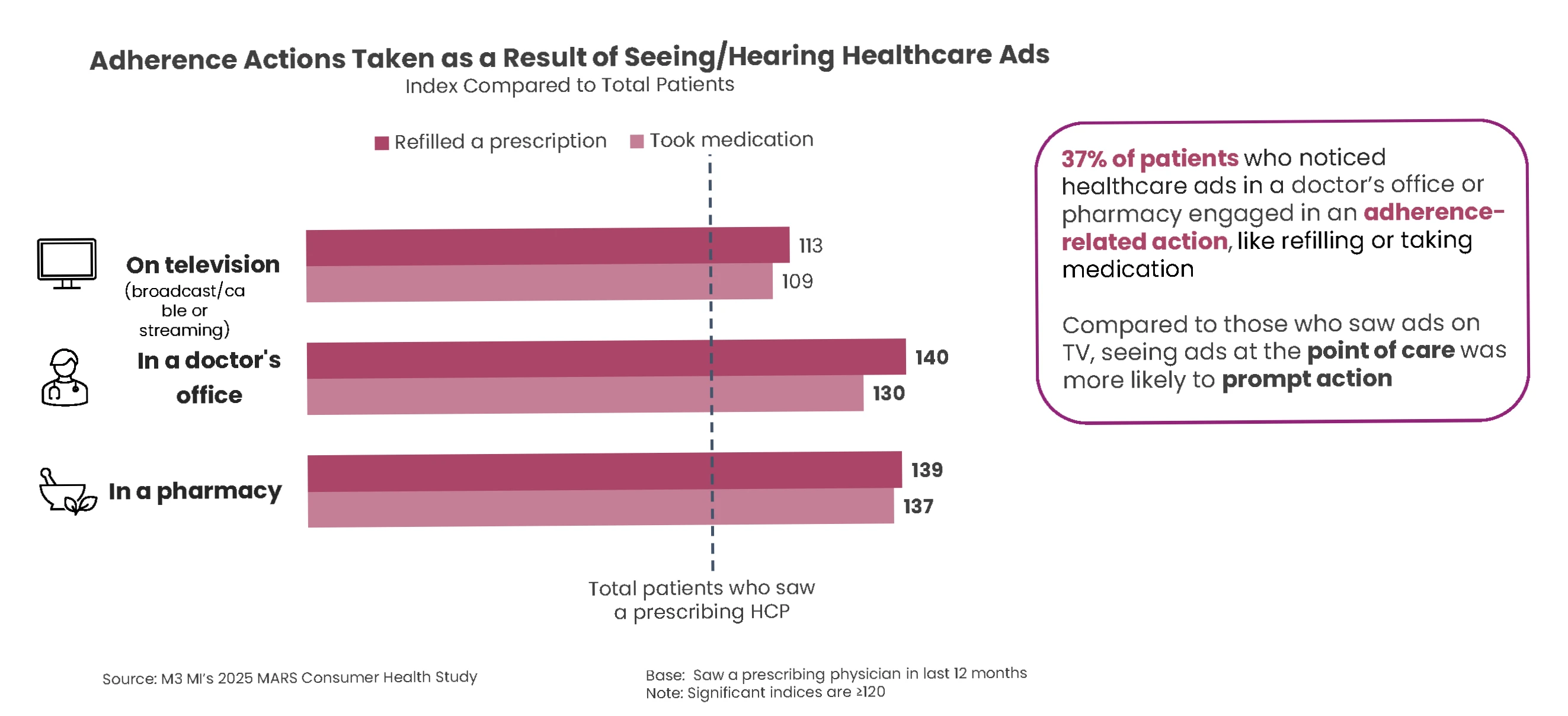
This difference underscores the power of context: messages delivered at the moment of care—when patients are already focused on their health—carry more weight than those encountered passively.
Key Point of Care Messaging Opportunities in 2026
For Patients: At the Pharmacy
The pharmacy continues to grow as a critical Point of Care environment. The research shows increasing patient appreciation for pharmacy-provided educational materials, reflecting the expanding role pharmacists play in counseling, adherence support, and care navigation.
- 86% of patients value pharmacists for health information
- Two out of three patients value printed brochures or other take-home health materials from a pharmacy, up 9% from 2022
- 34% of patients notice ads at the pharmacy, up 10% from 2022
As pharmacies evolve into community health hubs, POC messaging in these settings offers repeated touchpoints across the treatment journey.
For Patients: When Messaging Around Cost and Coverage
Cost and insurance coverage remain among the biggest barriers in the prescribing journey—particularly for lower-income patients. The study highlights:
- Persistent confusion around affordability options
- A decline in usage of discount drug programs - Low-income consumers (annual household income under $50K) are 24% less likely than the total Americans to be willing to pay extra for prescriptions not covered by insurance, and patient usage of brand-sponsored programs is down 13% from 2022, signaling a need for better education at the Point of Care
80% of physicians provide information about discount drug programs, and = 48% initiate those conversations themselves rather than waiting for patients to ask.
This trend suggests a clear opportunity for Point of Care education to clarify coverage, explain assistance programs, and reduce abandonment driven by financial uncertainty.
For Providers: Digital Media Within Clinical Workflows
Providers increasingly engage with digital tools such as EHRs and medical apps. Physicians spend an average of 4 hours per week reading medical content, with 84% of that time spent on digital media.
The research shows these environments are becoming important channels for education and support—particularly when messaging aligns with workflow and enhances efficiency rather than adding burden.
For Providers: Print Still Plays a Central Role
Despite the digital shift, print education remains the most widely used format for delivering information to patients. 73% of physicians distribute patient education via printed materials, compared to:
- 31% referring patients to a website
- 23% delivering education through EMR/EHR systems
Physicians continue to value tangible materials that patients can review at their own pace and share with caregivers.
Top Channels for Physicians
While digital adoption continues to grow, the study reinforces that no single channel dominates. Instead, effectiveness comes from a thoughtful mix of:
- Digital tools for quick reference and reinforcement
- Print materials for patient handouts and take-home education
What This Means for Healthcare Marketers
The findings from this research point to a clear conclusion: Point of Care messaging is uniquely positioned to support education, trust, and action in today’s healthcare landscape.
For marketers, success at the Point of Care requires:
- Prioritizing education over promotion
- Designing content that complements provider conversations
- Addressing real barriers like cost, access, and understanding
- Leveraging both digital and print formats strategically
When executed thoughtfully, POC messaging doesn’t interrupt care—it enhances it.
As patients continue to seek clarity amid complexity, and providers face mounting pressures on time and resources, the value of Point of Care education will only grow.
This research reinforces what POCMA has long championed: when credible, relevant information reaches patients at the right moment, it empowers better conversations, better decisions, and better outcomes.
For healthcare brands committed to meaningful engagement, reaching patients, providers, and caregivers, the Point of Care isn’t just a channel—it’s a responsibility.