From Foundation to Future: POCMA’s Board Co-Chairs Reflect on the Growth of Point of Care—and What Comes Next
BlogsThursday Mar 26, 2026
The Point of Care (POC) ecosystem continues to evolve over time as patient and provider behaviors shift and as healthcare technology advances - what began decades ago as printed materials placed in doctor’s offices has grown into a dynamic suite of educational tools, digital media and clinical workflow integrations designed to support conversations between patients and healthcare providers during the moments they’re making shared health decisions.
Today, thanks in part to the proliferation of different POC mediums, health brands are increasingly recognizing POC as a critical channel for healthcare communication—one that sits at the intersection of patient education, clinical decision-making and heightened attention and awareness.
But industries don’t evolve on their own. They evolve in part because market leaders push them forward.
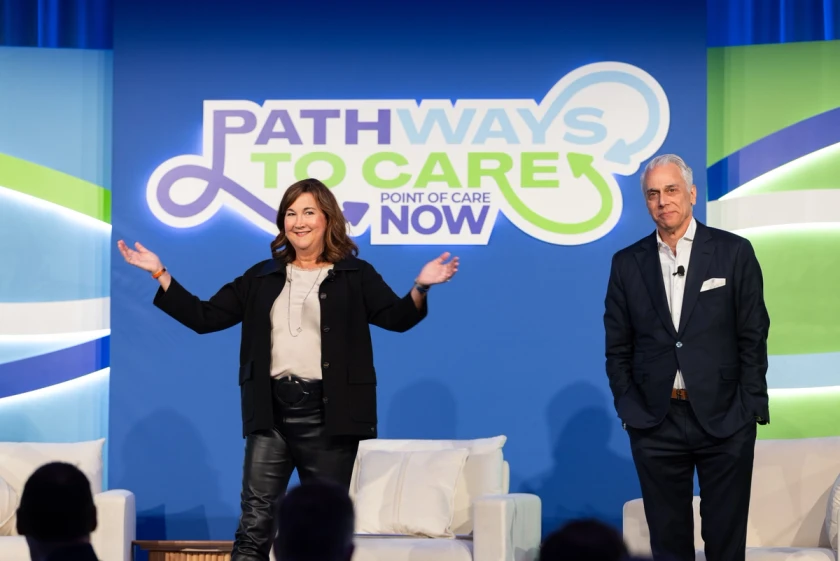
Just before POCMA’s annual POC Now Summit, we sat down with POCMA’s Board Co-Chairs—industry executives who guide the association’s priorities while advocating for the broader POC ecosystem-for a discussion on how they’ve seen the POC space change during their time advising the organization, as well as what their predictions are for the future of the growing channel.
Together, their stories reflect the past, present and future of POC. Each leader arrived in the space through a different path, but all share a common belief: that POC media fundamentally improves how health information is delivered, understood and acted upon by patients and HCPs.
Their reflections offer a look at how the industry has evolved—and what comes next.
Linda Ruschau: Elevating the Industry
Few leaders have been as closely connected to the evolution of Point of Care as outgoing POCMA Co-Chair Linda Ruschau.
Today, Ruschau serves as the Chief Commercial Officer at PatientPoint, one of the largest organizations in the POC ecosystem. But her path into the industry began rather with a role in CPG - until an early decision changed the trajectory of her career.
“I started my career at Procter & Gamble in their sales leadership program,” she recalls.
Despite the prestige of the opportunity, Ruschau sought a more entrepreneurial experience. That realization led her to join a startup called OnTarget Media in 1992.
“I think I was employee 15 in 1992 and I'm still there today,” she says.
Over the decades that followed, OnTarget Media evolved alongside the industry itself—eventually becoming PatientPoint. And, over this same time period, Ruschau, alongside PatientPoint CEO Mike Collette, another former Procter & Gamble leader, recognized the need to establish a formal association that would advocate for POC and uphold ethics standards.
That effort ultimately led to the formation of what is now POCMA.
From the beginning of POCMA’s formation, Ruschau believed the association needed to focus on collaboration rather than competition.
“I always say all boats rise when we collectively promote the incredible impact POC can have on patients’ health. No other channel gets you closer to both the doctor and the patient at the point of treatment decision. It should be a foundational tactic for any healthcare brand."

Linda Ruschau
Chief Commercial Officer, PatientPoint
That collaborative philosophy became a defining feature of Linda’s leadership as Co-Chair, which ended in March.
During her tenure as Co-Chair, POCMA expanded its focus beyond simple networking toward industry thought leadership and education. One example of this push into thought leadership is the formation of the Candid Conversations event series, a forum designed to bring industry professionals together for meaningful dialogue about how pharma can be a better partner to HCPs, caregivers and the patients they serve at the Point of Care.
“We started this [event series] instead of doing [just] happy hours,” Ruschau says of the organization's investment in Candid Conversations. “What’s a hot topic in the industry and how do we bring together pharma in a safe space to ideate and talk about it?”
The initiative reflects a broader goal: positioning POC (and its media partners) as a strategic healthcare channel rather than simply another media placement.
Ruschau also helped lead one of the association’s most significant initiatives—advocacy efforts in Washington, D.C.
Recognizing that direct-to-consumer (DTC) pharmaceutical advertising faces potential regulatory challenges, she pushed the organization to engage policymakers proactively.
“We brought every member together and said we have to tackle this,” she says.
That effort led to the association retaining a DC-based advocacy firm and organizing a visit to Capitol Hill to educate lawmakers about the critical role Point of Care plays in healthcare communication.

For Ruschau, the experience was deeply meaningful.
“Getting to go behind the walls of the Senate and the House and talk about the unique and proven value that Point of Care offers was an incredible and unique experience.”
But the real impact of POC goes far beyond policy conversations or marketing metrics. It shows up in patient outcomes.
“We are changing patient’s lives,” she says. “Through education and messaging we are getting more people on treatment that they need and ultimately helping them live longer, healthier lives."
That mission-driven perspective has shaped her career—and the industry she helped build.
Dave Paragamian: Advocating for a Channel That Delivers
For continuing co-chair Dave Paragamian, the power of Point of Care lies in its impact.
Paragamian, CEO of Health Monitor Network, first became involved with POCMA roughly five years ago. His early involvement included chairing the organization’s membership committee before eventually stepping into the role of Board Co-Chair.
Over that time, his conviction about the importance of POC has only strengthened.
“I believe that Point of Care is a critical element of a marketing plan,” he says. “Not a nice to have…but a critical element.”

Dave Paragamian
CEO, Health Monitor
One of the reasons for that belief is the measurable return the channel can deliver relative to the investment brands make in it - as an example, he points to an industry analysis that examined marketing mix performance for a biologic brand.
“Two percent of the spend was in Point of Care but it delivered 17 percent of the NRXs,” he explains.
For Paragamian, that type of performance underscores why the industry must continue advocating for the channel.
“Point of Care punches above its weight class.”
Advocacy has been a central focus of his leadership at POCMA: One milestone he highlights is the rapid expansion of the association’s membership over the past year.
“In the past 12 months we've added 10 new member companies… a 25 to 30 percent increase in members coming to the table saying [they] see value in being part of the conversation.”
That growth reflects a broader shift in how the industry views POC - what was once perceived by pharma and media buyers as a narrow set of placements has evolved into a diverse ecosystem of formats and technologies.
“There was a time 30 years ago when we were limited to just a printed patient guide in a doctor's office,” Paragamian says. “Then there was a time…when it was a printed patient guide AND it was a screen in a doctor's office. Today…we have 13 different tactical products that we can offer to clients in an omni-channel way.”
This diversity—across companies, technologies and formats—is what excites him most about the future of the industry.
“The terrific thing is the diversity of member companies and the diversity of the tactical surfaces they bring for marketers.”
Yet despite that impressive growth, Paragamian believes the association’s mission remains the same: advocating for the channel itself.
“We're not advocating for an individual company…or tactic,” he says. “We advocate for the sake of the channel—the rising tide lifting all boats.”
As Ruschau concludes her tenure as Co-Chair, Paragamian is quick to recognize her leadership and thought partnership.
“It has been a true pleasure to collaborate with Linda as co-chair,” he says. “She is a wonderful partner and co-chair and always a thoughtful, smart, strategic value-add person.”
Wills Robbins: Innovation and the Next Chapter
Incoming Co-Chair Wills Robbins represents the next phase of POCMA’s evolution.
Robbins is the Founder of Constant Media, a company he launched in 2011 after recognizing an opportunity to modernize POC communication through digital innovation.
“I have been in the [POC media] space for over 20 years,” Robbins says.
Earlier in his career, he worked for a company focused primarily on poster placements within healthcare environments. But as technology began transforming the industry, he saw a shift coming.
“Clients were asking, ‘Do you have video?’” he recalls.
That insight ultimately led him to launch his own company.
For Robbins, the motivation behind founding Constant Media—and his involvement in POCMA—has always centered on improving communication within healthcare.
“Our motivation as a company has been to enhance the dialogue between the healthcare provider and the patient, improve health outcomes, and then with that you'll have a great conversation that brands would like to be a part of.”

Wills Robbins
Founder of Constant Media
That philosophy closely aligns with POCMA’s mission.
When Ruschau nominated Wills to step into the role of Co-Chair, Robbins says he felt honored—and motivated to contribute.
Looking ahead, he believes the next phase of POC will be shaped by technology and innovation.
“What excites me most is positioning ourselves as a way to improve the efficiency of the healthcare provider,” Robbins explains.
That efficiency will become increasingly important as demographic shifts reshape healthcare demand.
“More and more people are going to be in the health system because people get older,” he says.
As patient volumes increase and time with providers becomes more constrained, POC tools can help deliver critical information at exactly the right moment in the care journey.
For Robbins, that future represents a significant opportunity—not just for marketers, but for patients and providers as well.
The Future of Point of Care
Across all three leaders we spoke with, one message is clear: the POC industry is ever-changing (and for the better).
Just fifteen years ago, many pharmaceutical brands didn’t allocate dedicated budgets for POC initiatives. Today, the industry has surpassed $1.2 billion in revenue among POCMA’s reporting members (based on 2025 projections) and continues to expand.
Ruschau believes the industry’s next step is ensuring the channel becomes a foundational part of healthcare marketing strategy.
“My hope is that POC stops being an afterthought,” she says. “Point of Care should be the foundational part of the marketing plan.”
Paragamian sees continued growth coming from the increasing diversity of solutions available across the ecosystem. And Robbins believes new technologies—from digital tools to remote monitoring—will expand how point of care supports healthcare delivery.
Together, their perspectives reflect an industry moving from experimentation toward maturity. But perhaps more importantly, they also reflect a shared commitment to improving healthcare itself. Because at its core, POC media is not just about marketing. It’s about helping patients and providers make better decisions—together.