Oftentimes when discussing Point of Care (POC) marketing, the conversation centers around branded messaging and its ability to influence outcomes like competitive differentiation and script lift. These types of campaigns are undeniably critical components of the healthcare marketer's toolkit. However, there’s an equally powerful side to the POC ecosystem that focuses purely on disease awareness, health literacy, and empowering patients to make more informed decisions: the unbranded campaign.
Unbranded campaigns play an essential role in healthcare. By helping patients better understand their overall health and preparing them for informed conversations with their care teams, these initiatives inform and empower without promoting specific products.
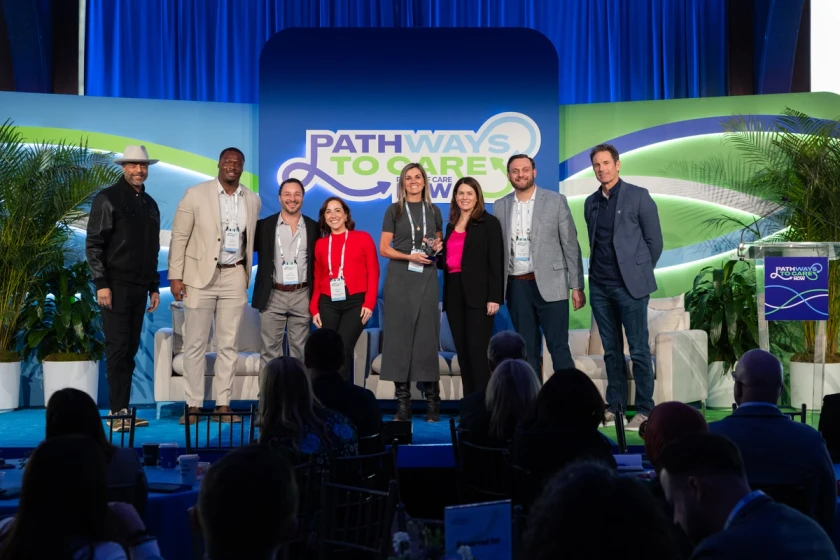
At this year’s POC Now Summit, the industry gathered to honor the campaigns and teams elevating the standard of healthcare engagement. Taking home the Best Unbranded Campaign award was Phreesia Network Solutions for their innovative pediatric health and wellness partnership with Sesame Workshop.
Their goal? Educate parents and caregivers about pediatric health.
To unpack the insights, execution, and results behind this award-winning campaign, we sat down with Phreesia’s David Linetsky and Shanoor Seervai. In our conversation, they detailed how combining data-driven precision with the "magic and whimsy" of trusted Sesame Street characters created a monumental shift in how patients consider and communicate about pediatric health at the Point of Care.
The Campaign’s "Special Sauce" - Partnering with Sesame Workshop to Build Trust
"The target audience was parents of young children. We were really focused on children under five," David said. "And we chose Sesame Workshop to partner with because many of the parents of children this age grew up watching the show and have incredibly positive memories and strong associations with the characters."
This familiarity became the vehicle for the campaign’s health messaging. "The goal was to leverage that familiarity and to use that to help parents get really helpful content about general well-being that they could use to make better decisions for their children, to build some trust between themselves and their providers and to promote good conversations with their doctors," David explained.
While the Point of Care offers a high-trust environment, the team also recognized broader societal challenges regarding medical credibility, particularly in pediatric settings.
"At this moment in history, we're starting to see a little bit of erosion in trust, particularly in pediatric settings," David observed. "And bringing in a brand like Sesame Street, an incredibly trusted brand, was a very deliberate choice on our part... We wanted to promote trust in that relationship again. And using these incredibly familiar characters in an organization that's so committed to doing high quality and evidence-based work was definitely the right choice here."
Partnering with an organization outside of the traditional pharmaceutical or medical publisher sphere allowed the campaign to tap into deep-seated nostalgia and universal affection. While the Sesame Street brand is universally beloved, survey data revealed that only 24% of parents and caregivers were very familiar with Sesame Workshop’s specific health content prior to the campaign. This presented a massive opportunity to introduce them to high-quality, evidence-based wellness materials from a brand they already connected with.
The Power and Purpose of Unbranded Campaigns
For marketers accustomed to promoting specific therapeutics, pivoting to an unbranded approach requires a shift in mindset. The goal moves from driving a specific prescription to fostering foundational health awareness and dialogue.
When discussing the strategic decision to run an unbranded campaign for this initiative, David was clear on why this approach was essential: "Unbranded was the only choice, because we're not trying to inform this audience about a specific therapy. In fact, this is not an audience that is defined by a particular diagnosis or a particular condition. The goal here was a promotion of general health and trying to help people with problems that are not necessarily a specific disease state."
By removing the branded element, marketers can engage patients at the earliest stages of their healthcare journey, often before a diagnosis is ever made. This approach fundamentally alters the dynamic between the brand, the patient, and the provider.
"I think there are a lot of cases where unbranded is the right option," David noted. "It helps build trust. It really feels more like support and education rather than direct advertising, which often is incredibly effective but isn't always what's needed in every moment."
In an era where patients are inundated with complex medical jargon and conflicting information online, providing straightforward, supportive education establishes a foundation of credibility.
Understanding the Audience: A Data-Driven Approach to Pediatric Health
Before launching any creative assets or finalizing partnerships, the Phreesia team recognized the need to deeply understand their target audience. The campaign focused on parents and caregivers of young children, but the team did not make assumptions about what this demographic actually needed.
Caregivers today face an immense responsibility in making healthcare decisions for their children, but they are also navigating tight time constraints due to family demands and a constant barrage of information. Knowing that a typical pediatric wellness visit lasts only 15 to 20 minutes—during which providers must tackle vaccinations, developmental milestones, and screenings—the team knew their messaging had to be immediately relevant and concise in order to adequately prepare parents for the appointment.
"We wanted to promote health and well-being,” David shared. "And we knew that we could do that given our accomplishments across hundreds of other campaigns over the years. And we wanted to take a very data driven approach [to how we executed the campaign]."
To ensure the content they put out as part of the campaign would resonate, the team embarked on a massive research initiative. "We surveyed close to 3,600 parents and caregivers of children under the age of five to get a sense of what topics they wanted to hear about and what topics they wanted help with," David explained.
The sheer scale of this research yielded highly specific, actionable insights that varied significantly depending on the age of the child.
"What we found came through pretty clearly, pretty consistently," David said. "For the slightly older end of that age spectrum, for the kids that are three to five, what we heard was a range of topics from emotional well-being to physical activity to hygiene."
Shanoor Seervai elaborated on these findings, noting that parents specifically requested help with "exploring and managing big feelings and healthy eating....they said these are the topics on which we need resources to talk to our kids."
Interestingly, the data revealed a completely different set of needs for parents of infants. "For the parents of the youngest kids... for kids under two, it was really about parental self-care, which I think really hit the mark when you're caring for an infant," David added.
By grounding their strategy in the self-reported needs of more than 3,600 caregivers, the team ensured their messaging would be immediately relevant and appreciated by their audience.
Meeting Parents in the "Activated State"
Armed with data-backed content pillars, the team’s next challenge was determining where to engage these parents. The Point of Care ecosystem was uniquely suited for this initiative because of the distinct psychological mindset patients and caregivers adopt when they enter a clinical environment.
"[We chose Point of Care because of its] proximity to this incredibly important moment where you interact with your healthcare provider, where shared decisions are made and actions are taken," David explained.
Unlike when they’re scrolling through social media or watching television at home, individuals in a healthcare setting are highly focused on their well-being. "Because you're actually thinking about your health when you're preparing for your visit," David continued. "You're sitting in a waiting room. Maybe you're checking in for your doctor's appointment, maybe you've just left it and are thinking about the follow-ups - you're thinking about your care. This is your most activated state. And it's that state in which you're most likely to take actions that are going to improve your health."
This "activated state" is crucial for pediatric health, where parents are constantly navigating a sea of contradictory advice. Shanoor highlighted this challenge: "There are a million things going on [for parents] and there's a million sources of conflicting information. We're seeing a lot of misinformation about the best decisions around health."
The clinical environment cuts through this noise. By reaching parents exactly when they have the capacity to act, the campaign aimed to achieve key outcomes: enhancing the provider's communication by focusing the conversation, creating space for reflection, building on trusted relationships, and ultimately driving stronger adherence to preventive care.
"POC is a moment when healthcare is top of mind," Shanoor noted. "You're about to go in and talk to a provider. And historically providers have been the people who patients place the highest level of trust in when it comes to health."
This alignment of trust and timing is the true superpower of POC media. "[Patients and caregivers] can ask [providers] about [a given topic] immediately and then they’re getting an answer from a source that they trust and can act on it immediately," Shanoor said. "Receptivity and capacity for action with the trusted source all align at the Point of Care."
Seamless Execution: Embedding Content in the Digital Workflow
A strong partnership and data-backed content topics only succeed if the execution is flawless. For Phreesia, this meant integrating the campaign directly into the digital pathways patients already use to navigate their care.
"Everything that we do is digital in nature...we try to meet patients where they are, and that usually means on their own devices," David stated.
To ensure the content appeared at the exact moments it was most useful, the patient experience was designed around three different touchpoints, accessible only after patients opted in via a HIPAA authorization form. "We focus on three moments - the moments leading up to a visit, the moments during a visit, and the moments after a visit. We created content for those moments specifically," David detailed.
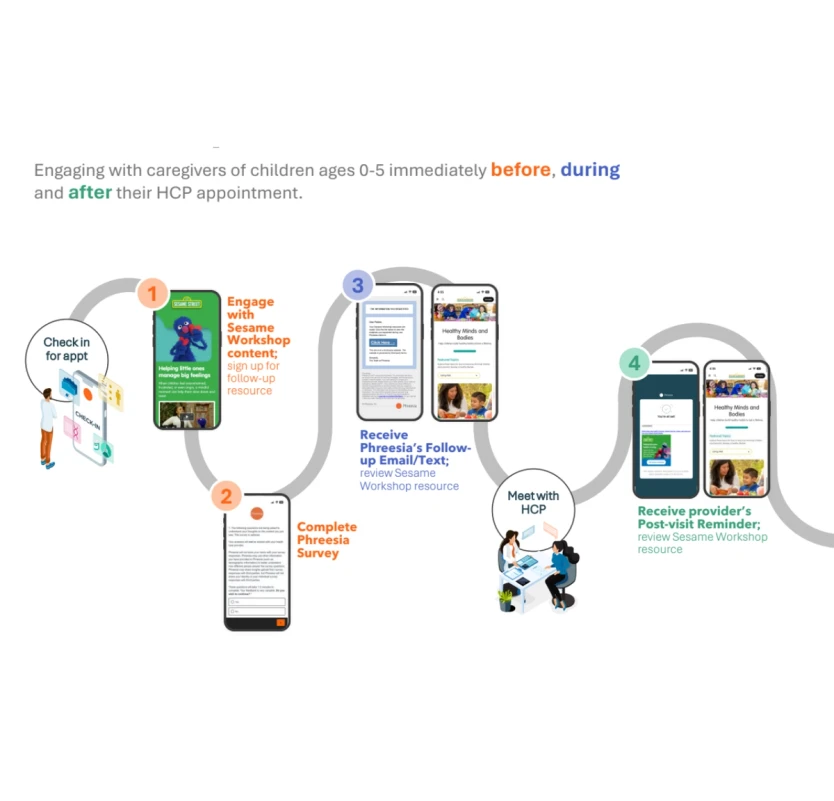
Workflow diagram
Rather than relying on static waiting room posters or physical brochures, the campaign lived within the digital check-in and intake processes. "Much of our work happens during the intake workflow," David explained. "In the previsit mode, we're embedded into the intake workflow... We're then able to send somebody information directly to their phone so they can take it into the exam room with them."
Creative Assets
The creative assets themselves perfectly balanced Sesame Workshop's iconic brand with the operational constraints of the Point of Care. For example, during the core "before visit" engagement, caregivers viewing the hygiene stream were greeted with catchy messaging and a static image of Elmo brushing his teeth, titled, "Brighter smiles start with a song!" Caregivers could then choose to watch a short video featuring Elmo's "Brushy Brush" song, showing how fun family resources can help children build healthy habits and routines.
If caregivers opted for additional resources, the second touchpoint activated a follow-up text or email delivered directly to their phone just 3 to 5 minutes later, right "during the visit." Finally, the "after visit" touchpoint engaged families a few hours post-appointment with a post-visit reminder containing a Sesame Workshop-branded banner ad. This ad seamlessly drove them to the Healthy Minds and Bodies page on the Sesame Workshop website for further pediatric health education.
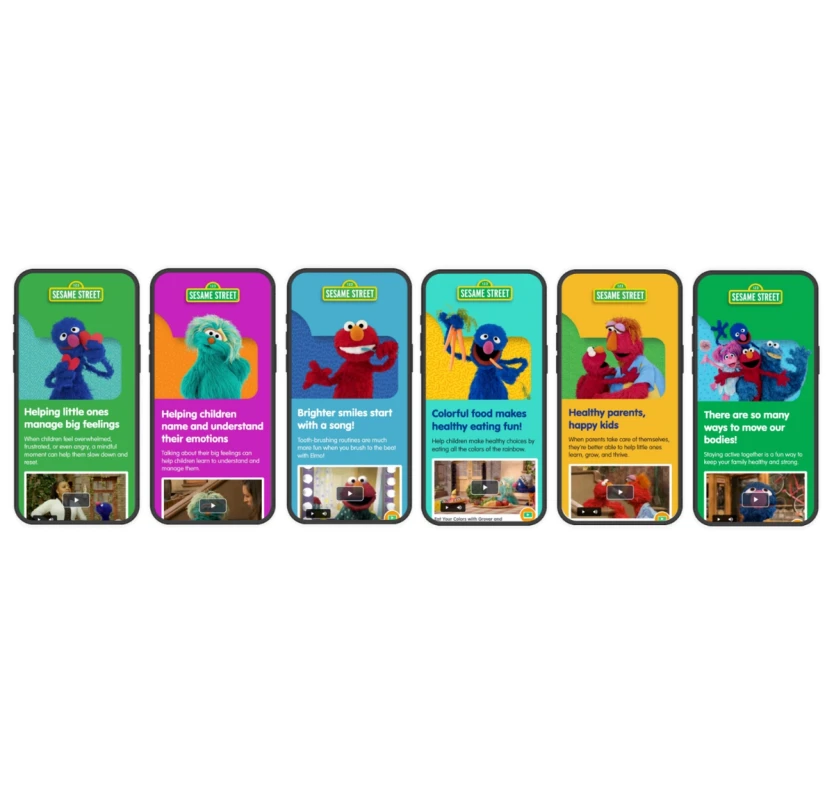
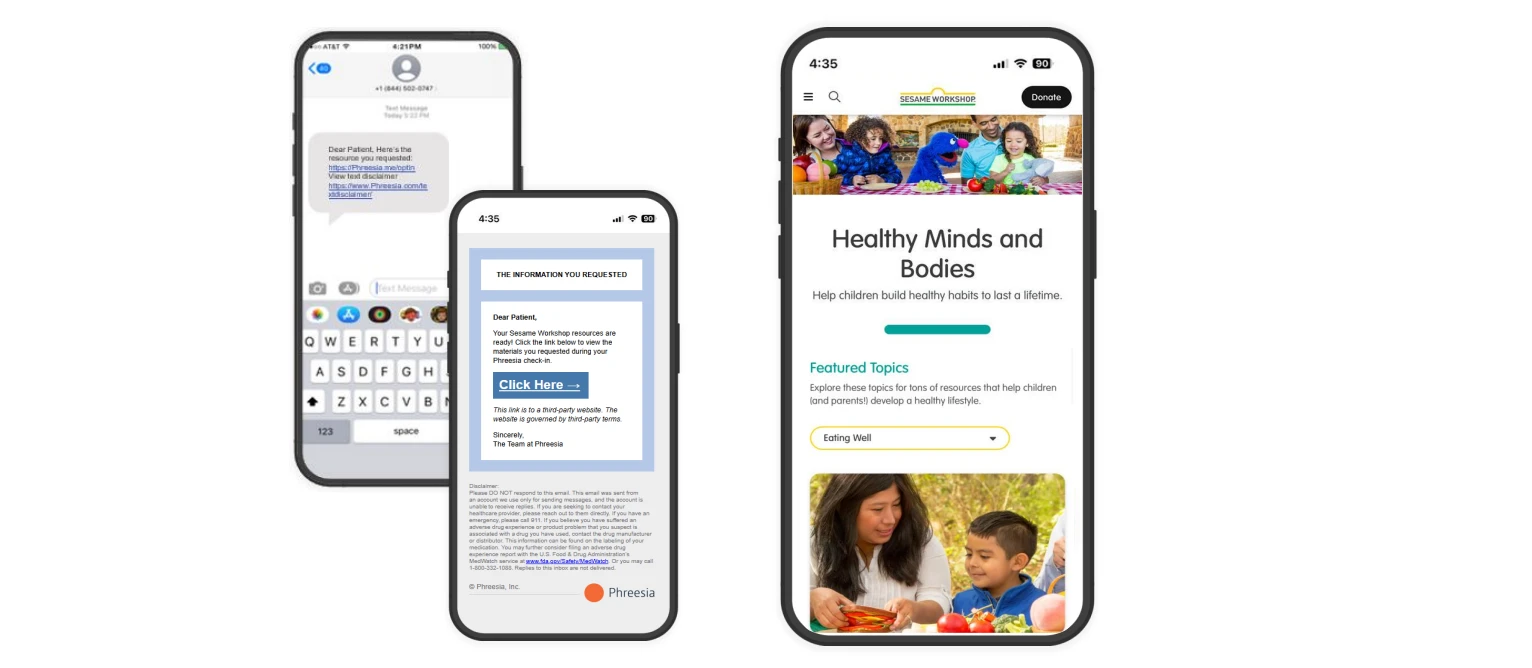
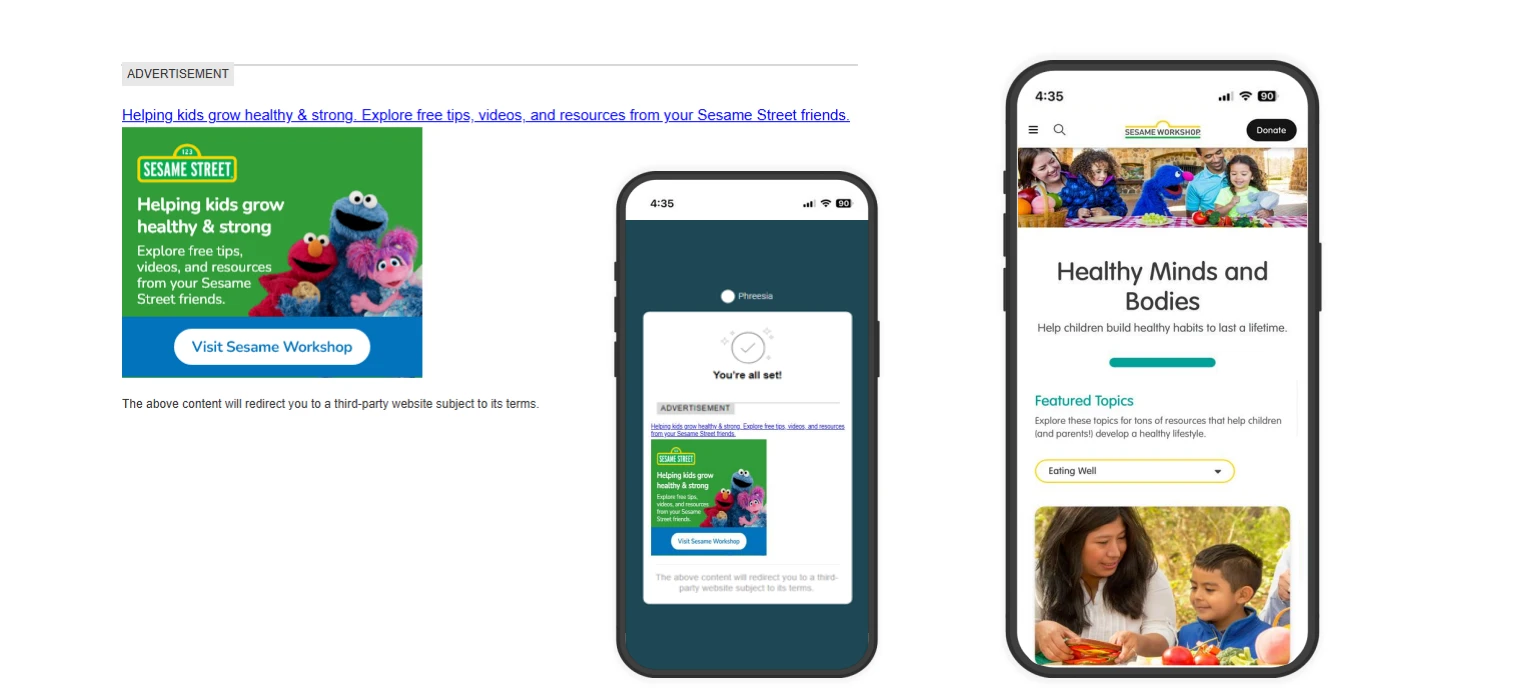
"[We combined] Sesame Workshop’s expertise in storytelling and [their] library of really incredible content that they've built over the years with our creative team, who are experts at how you take that content and fit it into this Point of Care moment," Shanoor shared.
Measuring the Magic: Surveying for Success at Massive Scale
Proving the efficacy of a broad, unbranded awareness campaign is notoriously difficult. Without a specific script-lift metric to track, the Phreesia team relied on robust, integrated surveying to validate their efforts.
"With this kind of general awareness campaign, the best option you have is surveying. You talk to the audience," David said. To do this efficiently, they built feedback loops directly into the user experience: "We append a short survey to the end of the campaign content."
Because the campaign was seamlessly integrated into the digital check-in workflow, it achieved an extraordinary level of reach. "We launched at the end of October and by the end of March, there were more than half a million engagements with the campaign," Shanoor revealed.
This massive scale provided statistically significant survey results, proving the campaign was a resounding success in the eyes of its core audience.
"91% of patients exposed said that the topics were important to them and over 90% said that the campaign was easy to understand," David shared proudly. "And over two-thirds of patients said it was very helpful."
A Blueprint for the Future of Healthcare Education
The Phreesia and Sesame Workshop campaign provides a masterclass in how to elevate healthcare marketing beyond traditional advertising. By marrying precise, data-driven topic selection with the emotional resonance of a beloved cultural institution, the team created an experience that genuinely supported caregivers in moments of need.
When asked for a key takeaway for other marketers looking to replicate this success, David pointed directly to the power of unexpected partnerships: "I think the special sauce here was the partner. Sesame Workshop are truly experts at storytelling, at engaging with people. I think the level of love for these characters is just so high and universal."
He urged the industry to broaden its horizons. "The general takeaway for marketers is to look outside of your industry. There are lots of organizations like Sesame Workshop that are experts in their fields... find those folks and bring them in and learn from them and see if you can work with them. And I think that brings magic into what we do in healthcare. And the more you can bring in magic and delight and whimsy, the more successful marketers can be in the space as well."
Shanoor echoed this sentiment, offering a poignant reminder of why we do this work in the first place: "Patients are often treated by our health care system as a sum of body parts and as a sum of medical conditions," she reflected. "When you look outside the industry to organizations like Sesame Workshop, you're seeing the patient as a whole person and you're seeing this other facet of their life. And then you're bringing it into a moment that can be really vulnerable because it's around your health, but it's also a really important time to influence behavior that can shape good outcomes."
By treating patients as whole people, leveraging trusted partnerships, and meeting parents and caregivers in their most activated states, Phreesia and Sesame Workshop delivered real, magical support right at the Point of Care.