The POC Planning Hub
Everything you need to build Point of Care into your next media plan — the proof, the strategy, and the tools to put it into action.
- Why it matters
- How to plan it
- Finding the right solutions
- Proof it works
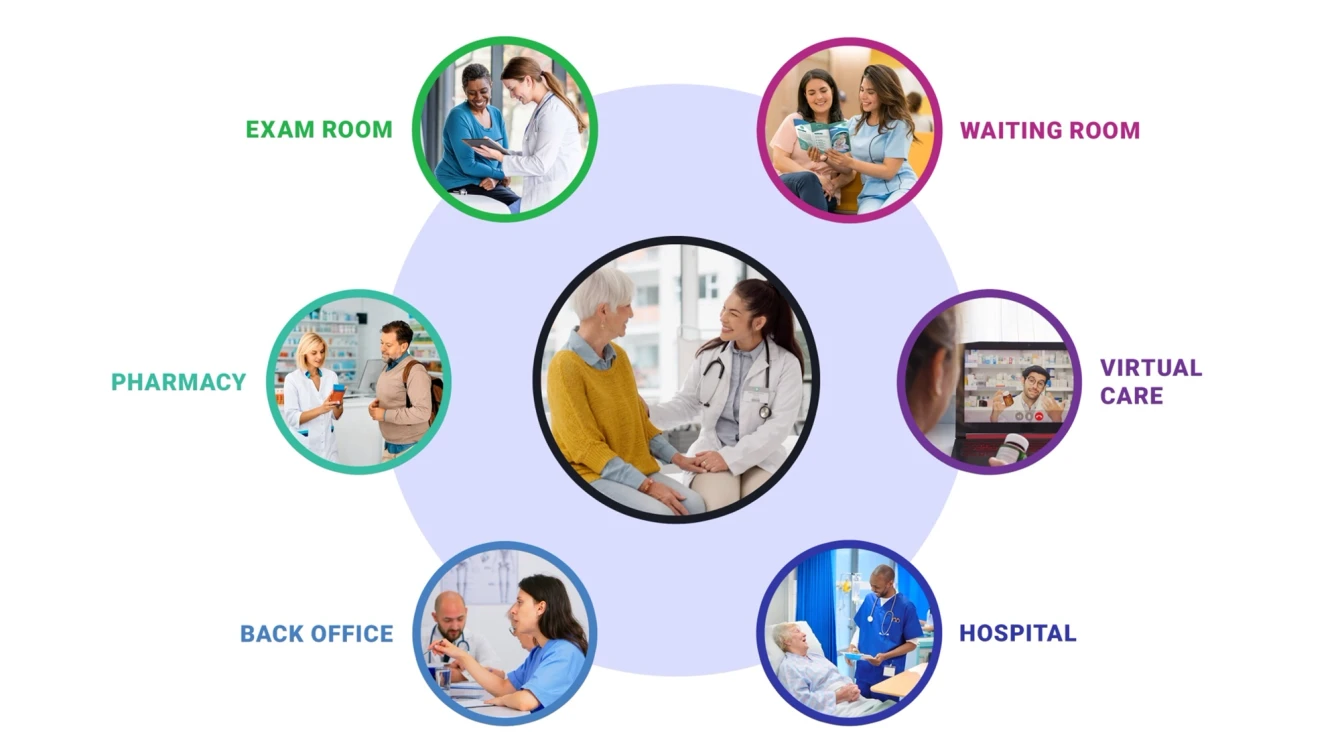
Every channel in your plan reaches an audience. Only one reaches them at the decision.
Point of Care reaches patients and providers exactly when a diagnosis lands, a treatment gets chosen, or a prescription gets filled. This hub gives pharma marketers and media buyers the proof, the principles, and the setting-by-setting tactics to build POC into the 2027 plan.
90%
of patients say education at the Point of Care is important to understanding their health.
60%
would ask their doctor about a prescription medication or sample they saw or heard advertised at the Point of Care.
60%
of patients who noticed a healthcare ad in a doctor's office go on to discuss new prescription medicines with their physician.
70% vs. 55%
filled a prescription or took a medication after noticing a POC ad, compared with patients who didn't notice one.
64%
of physicians would provide more support materials and tools if they were more customized to their patients.
1 in 4
physicians extend education beyond the office visit today — a clear runway for POC to close the gap.
Sources: M3 MI 2026 MARS Consumer Health Study · M3 MI 2025 Sources & Interactions + Digital Insights Study
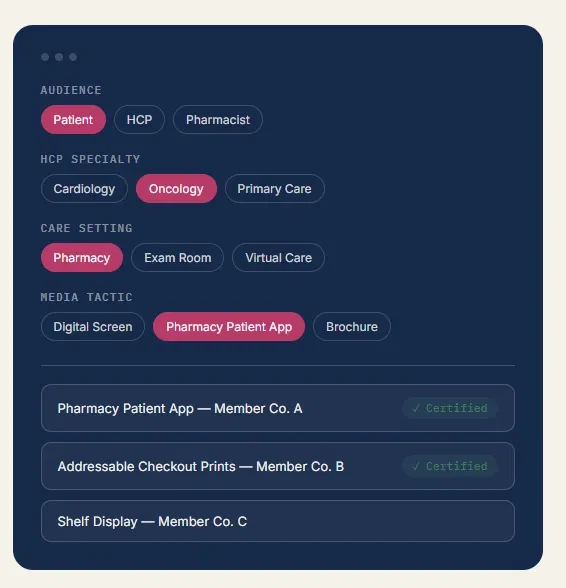
Find the right POC products for your media plan
Explore Point of Care media solutions across POCMA member companies. Filter by audience, HCP specialty, care setting, and media tactic to identify solutions aligned with your campaign objectives — and see at a glance which products are POCMA certified.
View results in-platform or download them for planning and collaboration with your team and media partners.
Please note: results do not reflect real-time inventory availability.
10 Principles for Building High-Impact POC Campaigns
Point of Care (POC) media reaches patients and providers at the moments that matter most — when a diagnosis is being made, a treatment is being considered, or a prescription is being filled. POC works because it meets people where decisions already happen. These 10 principles will help you build campaigns that are relevant, trusted, and measurable.
Phase 1: Plan
Phase II: Engage
Phase III: Optimize
Target Moments of Decision
The care journey is full of decision points. Map them before you build your plan— diagnosis, treatment selection, adherence, follow-up. Your campaign should be engineered around those moments of action, not retrofitted to them.
Build the Right Audience
The right audience isn’t just who generates claims — it’s who shapes care. Start with the full clinically relevant universe, narrow by objective, and prioritize influence. Bring clinical expertise into planning early.
Target with Precision
Precision starts with the right data. Use deterministic clinical, behavioral, and
identity-based signals — diagnosis codes, prescribing activity, lab results, EHR context, and retail pharmacy insights — to target with relevance. Flight strategically: 12-month campaigns drive the best outcomes; six months minimum for pilots.
Bridge HCP and Patient Engagement
Coordinate patient and HCP engagement across key touchpoints — ensuring
messaging is aligned for both audiences — to reinforce continuity and maximize the impact of your omnichannel strategy.
Plan for Compliance Early
The most effective POC programs align early with legal, privacy, and regulatory
teams. As AI, personalization, and healthcare data become more integral to execution, proactive collaboration enables innovation, reduces risk, and accelerates deployment.
Phase II: Engage
Integrate, Don’t Interrupt
The most effective POC feels useful, not promotional. For patients, that means
showing up from diagnosis through adherence. For providers, it means embedding into the systems and workflows where decisions actually happen.
Optimize for the Environment
Each Point of Care setting presents a unique opportunity for engagement.
Tailor creative, messaging, and formats to the context. A one-size-fits-all undermines POC’s core advantage.
Lead with Education, Not Promotion
POC environments are emotionally charged. Patients are navigating uncertainty — deliver credible, relevant content that helps them feel informed, supported, and prepared to make decisions with greater clarity and confidence. Educational messaging builds trust — and trust drives action.
Don’t Overlook Pharmacy and Care Teams
Pharmacists, nurses, specialty pharmacies, and other care team members influence treatment initiation, access, affordability, and adherence. Build them into your POC strategy as a core part of how care gets done.
Define Success and Measure What Matters
Align stakeholders on objectives, KPIs, and measurement plans before launch. Focus on outcomes such as prescription lift, treatment initiation, adherence, and patient activation, and leverage third-party measurement and MMM to connect campaign performance to real-world impact.
Go Deeper: Planning Resources



Patients are overloaded with information — not clarity
Trust is built through curiosity, not correction
Repetition across the care journey supports learning
Care is delivered by teams, not individuals
Generic education tools no longer work
Cost and usability are major drivers of adherence
AI is already shaping healthcare conversations
Value is defined by workflow fit, not presence
Case Study
The Effectiveness of Point of Care
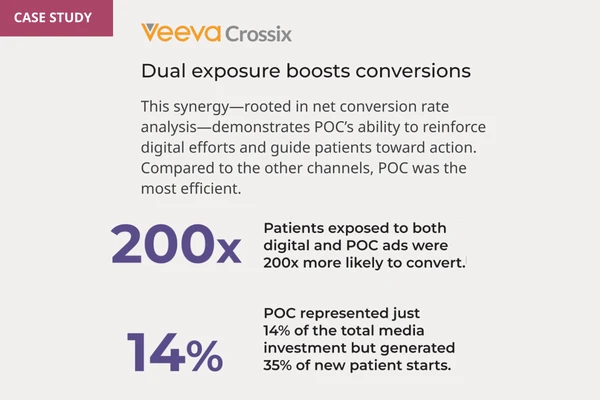
When integrated with digital and television campaigns, Point of Care media significantly amplifies healthcare marketing performance.
A Veeva Crossix case study demonstrates how combining POC with other channels increases conversion efficiency and drives measurable patient action—highlighting the power of cross-channel exposure in modern healthcare media strategies.4
Sources
- M3 MI. (2024). 2024 MARS Consumer Health Study
- Point of Care Marketing Association (POCMA). “Point of Care Cross-Channel Impact.” https://pocmarketing.org/resources-insights/point-of-care-cross-channel-impact
- POCMA. (2024). Healthcare industry spending details. [Internal data] sourced POCMA member reporting
- Veeva Crossix, The Effectiveness of Point of Care: Case Study Analysis (2023), via POCMA