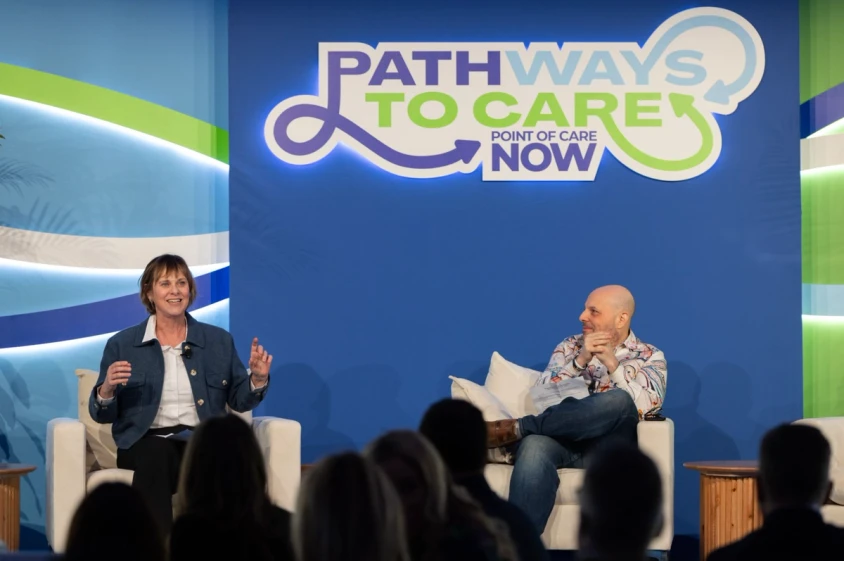
At this year’s POC Now Summit, one of the most compelling—and unfiltered—conversations came from two individuals who have experienced the healthcare system not as marketers, but as patients navigating it in real time.
Matthew Zachary is a longtime patient advocate and Co-Founder of We The Patients, an organization dedicated to amplifying the lived experience of navigating the U.S. healthcare system. Over the past two decades, Zachary has built platforms, advised industry stakeholders and led national conversations around patient engagement, healthcare policy and the role of lived experience in shaping better systems and communication. Diagnosed with brain cancer at just 21 years old, Zachary has spent decades challenging how the industry communicates with—and often overlooks—the human reality of patients.
Joining him was Jen Singer, a longtime medical writer whose work has helped leading health systems translate complex clinical information into accessible, patient-friendly content. Also a cancer survivor and heart failure patient, Jen has experience on both sides of the healthcare equation—as both communicator and care recipient—and brings a uniquely informed perspective on what patients actually need to understand, process and act on in real-world settings.
Together, Zachary and Singer collaborated as author and ghostwriter, respectively, on We the Patients: Understanding, Navigating, and Surviving America’s Healthcare Nightmare, a book grounded in firsthand experience and a shared mission: to challenge assumptions about how healthcare communication is designed—and who it’s really designed for.
At the Summit, their conversation—We the Patients & the Rx for Attention—focused on a critical perspective:
The biggest gap in healthcare communication isn’t reach. It’s relevance.
Patients walk into a waiting room already influenced by what they’ve seen online, what they’ve heard from others, and what they believe or fear in that moment. And while the Point of Care offers a high trust, context-rich environment for deeper engagement, POC media is still too often designed without fully considering relevance to the patients involved.
At the POC, Zachary and Singer assert, brands aren’t just competing with each other. They’re competing with something far more powerful: the patient’s emotional state.
As Singer put it plainly: “The number one thing you're concerned about when you're a patient is [that] you're scared to death.”
“[Pharma brands] have an opportunity to assuage our fears, make us feel heard and feel like human beings.”
The opportunity—and the challenge—for pharma is not simply to be present at the POC. It is to earn attention, trust and relevance at an emotional time in the patient’s journey.
Here are some of the key takeaways for marketers from Matt and Jen’s conversation that can help you meet patients where they are.
The Waiting Room Is Not a Media Channel—It’s an Emotional Environment
For pharma marketers, it’s easy to think of the waiting room as just another placement opportunity.
A screen. A poster. A brochure. A captive audience.
But for patients, it’s something entirely different. It’s a moment filled with uncertainty, vulnerability, and often fear.
Singer described the waiting room through the lens of her lived experience: “I’ve been in waiting rooms as a medical writer… [so] I know what the patients are feeling.”
And what they’re feeling is not passive or receptive. What’s more, the media they’re exposed to often misses the mark entirely:
“The TV playing…the Fresh Prince of Bel Air is not helping them. [And] there's a lot of information you can get [in the waiting room] that you don't need to know right away, and it's overwhelming.”
This disconnect points to a fundamental misunderstanding: Patients aren’t entering the Point of Care as calm, rational consumers of information. They’re arriving overwhelmed, distracted, and often unsure of what matters most.
As Singer explained: “If you have a major diagnosis, [or even] if you have a minor diagnosis, you're still confused, and often going online makes that worse.”
Singer asserts that patients don’t just need accurate information–they need information they can understand—and use right then. And brands can play a role in filtering information to only what’s relevant at that moment or step in the care journey.
Without that filtering from pharma, patients are left to navigate overwhelming—and often misleading—information ecosystems.
“I kept seeing patients come in and they're terrified because they Googled heart failure and thought they're going to be dead in five years,” said Singer.
What Marketers Can Take Away
The implication for marketers is clear: The solution isn’t providing more information in the waiting room. It’s providing only relevant information mapped against better sequencing, clearer framing, and more intentional delivery.

Designing for Emotional Reality, Not ‘Ideal’ Conditions
In their conversation, Zachary and Singer stressed that patients do not experience healthcare in ideal conditions. They experience it in moments of stress, uncertainty, and cognitive overload.
Zachary framed this reality through his own experience: “[When you’re sick], it's kind of a ‘[stuff] happens’ store that you don't want to be shopping in and you didn't rehearse to be in. There's no Yelp guide on what to do.”
This is not a setting where dense information thrives. It’s a setting where clarity, simplicity, and emotional awareness are essential.
And yet, Zachary and Singer shared, much of the content they’ve seen delivered at the Point of Care is designed as if patients are operating at full cognitive capacity.
What Marketers Can Take Away
This is where pharma messaging needs to become strategic and speak directly to the emotional state of the patient. What information will patients be able to digest when in this heightened emotional state?
Pharma teams won’t control the diagnosis. They may not control the environment. But they do control how they present information about their therapy. And that control matters. Because reducing cognitive load for patients isn’t about simplifying the science—it’s about respecting the environment.
In practice, respecting the environment looks like focusing your messaging by using plain language and visual simplicity. Doing so will directly impact patient comprehension, trust and action.

Tone Is Strategy—Not Just Compliance
If plain language and visual simplicity determine whether patients can easily understand and retain information, tone determines whether patients will trust it.
And, according to Zachary and Singer, tone is one of the most underleveraged tools in healthcare communication. Because even within strict regulatory frameworks, brands still have choices in how and what they message to patients.
They can choose to sound institutional—or human. They can choose to reassure—or to acknowledge reality.
Zachary highlighted the emotional gap that opens when patients aren’t spoken to as humans: “When I walk into [a] cancer center, someone should [say], We're sorry you're here.”
But that simple acknowledgment rarely happens from pharma, Zachary and Singer assert. Instead, pharma communications sometimes default to polished, optimistic narratives that feel disconnected from the patient experience.
Zachary challenged these overly optimistic portrayals directly: “Why are there bathtubs on beaches? Why do these TV ads not speak to the things that I want to understand?”
The result? Messaging that may be compliant—but not credible. When messaging fails to align with the patient’s reality or speak to their mindset in the moment, the impact isn’t neutral - it creates friction, distrust, and disengagement.
Zachary pointed to a telling example from market research to prove his point: “Breast cancer patients don't like to see advertising with happy breast cancer patients in them.”
Why? Because it doesn’t reflect their lived experience.
“Breast cancer is not a party,” Zachary shared.
Patients are not looking for idealized narratives, Zachary and Singer argue. They’re looking for guidance that acknowledges where they are—and helps them move forward.
To build credibility, Zachary and Singer recommend striking a tone in POC communications that gives patients permission to feel what they’re actually feeling and validates those feelings.
They suggest that patients who aren’t told what to feel, but rather feel seen by pharma communications, create connections with those communications.
Zachary described what the underlying promise could look like for cancer patients as something akin to: “We're angry too. We're sorry. You're here… Let's help you figure this out together.”
What Marketers Can Take Away
Authenticity is about being emotionally accurate and realistic. Patients need recognition and language that reflects what they are actually experiencing. This shift—from aspirational messaging to empathetic acknowledgment—is a key trust-building strategy.

Point of Care vs. Point of Need
To build better, more effective POC messaging, perhaps the most important reframing introduced in the conversation was Zachary’s distinction between Point of Care and what he calls the “Point of Need.”
Because while marketers can think in terms of clinical moments, patients experience something very different. Zachary explained: “Point of Need is about the person that doesn't know what they need, that needs to be told what they can do.”
Thinking about POC messaging as the Point of Need shifts the focus from information delivery to intervention. One helpful question Zachary encourages marketers to ask when designing POC communications is: “What does that human need to feel, not see, hear or read?”
And he advises marketers to acknowledge that those needs can extend far beyond treatment options. Relative to a diagnosis or care plan, patients might be thinking: “How is it going to look [for] my career? Will my [partner] still [be attracted to me]? Will my children understand what's going on with [me]?”
These are the questions that define the patient experience. And considering them when designing POC messaging can help you get it right.
The Role of Early Perspective: Pressure Testing for Clarity
So, how do marketers go about actually getting into the patient mindset in order to design better POC communications? One of the most actionable takeaways from the conversation is the importance of bringing patient perspective into the process earlier in campaign planning.
Not after launch. Not after optimization. Before finalization.
Doing so starts with understanding how patients interpret what they’re given. Marketers can gain that understanding by conducting market research, message testing or focus groups leveraging real patients.
Competing for Attention Is Not Enough
Ultimately, Zachary and Singer’s conversation is a reminder that getting Point of Care right just isn’t about optimizing placements—it’s about rethinking perspective.
They cautioned marketers that making assumptions about patient behaviors and mindsets is an unnecessary risk - Patients aren’t passive recipients of information; they are navigating fear, uncertainty and real-life implications in real time.
The brands that will stand out are those that design for that reality—meeting patients with clarity, relevance and emotional intelligence in the moments that matter most.
Because in an environment where attention is fragile and trust is hard-earned, patients seek understanding. And when Point of Care communication reflects that understanding, it becomes meaningful support at the exact moment patients need it most.
Watch We the Patients & the Rx for Attention on demand here.